

We’ve been working on this one for a couple of months now and finally got around to publish it albeit nearly 4 months later than the initial deadline we constrained ourselves by but we hope you enjoy it.
Thesis
Coca-Cola is the purest corporate form of an asset-light, brand and distribution moat. The Coca-Cola Company sells syrup concentrate (the capital light aspect); an aligned network of independent bottlers sells the finished product (the capex heavy bottling operations); the parent captures a piece of system revenue and the the parent earns the dominant share of system profit on roughly 10% of system headcount. The 1899 bottling contract, the 1893 trademark (reinforced by the 1905 re-registration and the 1920 Koke ruling)., the 1916 contour bottle, the 1980 Soft Drink Interbrand Company Act, and the 2010s re-franchising program are five layers of the same architecture. The brand is the most valuable asset; the distribution system is the least replicable one; the concentrate-model economics are what allow both to coexist on the parent’s P&L.
Introduction
In 1886 Atlanta, a morphine-addicted Confederate veteran named John Pemberton was mixing a non-alcoholic version of his patent-medicine wine. He would be dead within 3 years, having sold the rights for a few thousand dollars to a local pharmacist who saw what Pemberton did not — that the value lay not in the formula but in the system that would sell it. Coca-Cola began as a regional tonic; as of 2026 it is Interbrand’s seventh-most valuable global brand and the highest-ranked FMCG brand in the world.
The interesting question is how the architecture was built around the drink…whether that’s the contracts, distribution rights, the trademark fortress, or bottler economics (which incidentally is very different from Pepsi nowadays and I’ll probably cover this aspect in an Implication Report in the near future I hope).
Let’s dive in.
1. The Evolution (Acts I–VII)
Act I — The Medicine & The Myth (1860s–1880s)
Coca-Cola’s origin is rooted in the post-Civil War American South — a market awash in nostrums and miracle cures. John Stith Pemberton was a pharmacist and wounded Confederate veteran in Atlanta, scraping by selling patent medicines. Like many veterans of the era, he had become addicted to morphine for pain relief. In the 1880s a new craze arrived from Europe: cocaine, marketed as a wonder drug for everything from headaches to depression. Pemberton began by imitating a famous French tonic wine (Vin Mariani) that blended coca leaves and Bordeaux wine. His version the “Pemberton’s French Wine Coca” added kola nut extract for additional caffeine. The result was a bestselling 19th-century stack of stimulants: alcohol, cocaine, and caffeine in a single drink which was primarily popular in Atlanta at the time.
In 1885, Atlanta passed a Prohibition law banning alcohol. Pemberton’s “wine coca” had to go. He then set out to create a non-alcoholic version which is what’s today called a soft drink; soft for obvious reasons. The pivot was structurally consequential because removing the wine and repositioning the product as a refreshing beverage instead of a medicine meant that one could consume it anytime. Over months of experimentation, Pemberton crafted a syrup that combined sugar, citrus oils, vanilla, spices, and the signature ingredients: trace coca leaf extract (for a hint of stimulants) and kola nut (for caffeine). He used caramel for color and citric acid for tang. The caffeine content was several times what is in the present-day formulation, and there was a small but real dose of cocaine in each glass. The product name took its parts from each: Coca for the coca leaf, Cola for the kola nut. Within two decades, Coca-Cola contained neither cocaine nor much kola. The name remained its single most valuable asset to date.
On May 8, 1886, the first Coca-Cola was served at Jacobs Pharmacy in downtown Atlanta. It was sold as a soda fountain drink, mixed on the spot with chilled carbonated water. Soda fountains were the social hubs of the era. It looked like the local hangout inside every drugstore. Lexington’s Candy Shop in NYC still presumably offers that same method of delivery for the product, for like the last 100 years, along with another shop called Schimpff’s Confectionery in Jeffersonville, Indiana I believe. At first, Coke was marketed as a dual-purpose potion: a pleasurable “soda” as well as a medicinal “brain tonic” for headaches and fatigue. Pemberton’s bookkeeper-turned-partner, Frank Mason Robinson, coined the name “Coca-Cola” in Spencerian script and designed what became the iconic logo we see today for the most part. His bet was the name’s alliteration and hard C sounds would lodge in customers’ minds and the company's early advertising would echo for the next century.
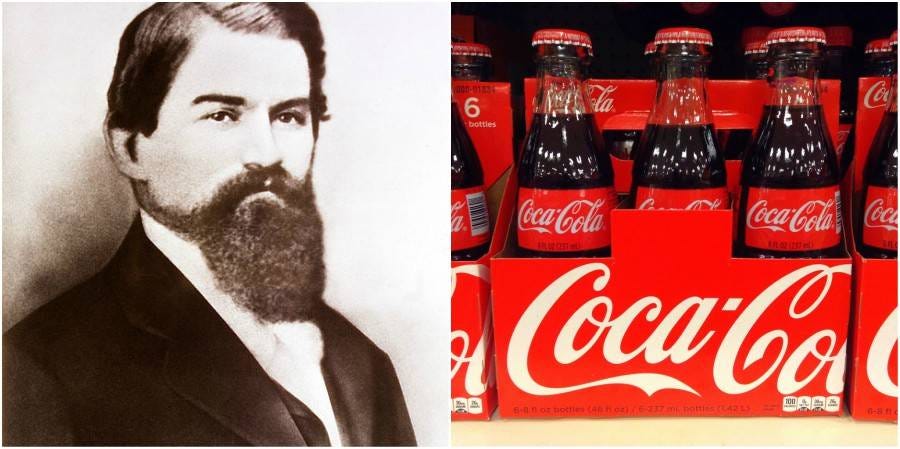
Source: All That’s Interesting. John Pemberton
Act II — Brand Building in a Bottle (1890s–1900s)
By 1887, Coca-Cola had modest success in Atlanta, selling perhaps a couple glasses a day and Pemberton, aging and ill, was not in shape to scale the business. In 1888, he sold off pieces of the formula rights to several parties to raise cash and multiple people claimed ownership when he died later that year. Frank Robinson, observing the chaos, approached Asa Griggs Candler, a local who specialized in the marketing of patented medicines. Between 1888 and 1891, Candler consolidated ownership for a cumulative outlay of roughly $2,300. In 1892, Candler and Robinson incorporated The Coca-Cola Company in Georgia as we know it. The trademark “Coca-Cola” was subsequently registered with the U.S. Patent Office on January 31, 1893.
Under Candler, Coca-Cola transformed from an inventor-driven experiment into a professionally run enterprise. Candler’s working theory was that Coca-Cola could be everywhere, for everyone. He plastered the Coca-Cola logo everywhere he could; on billboards, calendars, trays, clocks, you name it. And if a shopkeeper wanted an outdoor sign, Candler’s team would paint the entire side of the building with “Drink Coca-Cola”. Best thing is, all of this was on the house. Fasting forward to the 1890s, towns across the American South carried Coca-Cola signage on a ton of commercial surfaces. Candler also distributed branded novelties (pocket mirrors, fans, bookmarks, branded soda fountain equipment) to retailers, turning drugstores into pseudo-franchised Coca-Cola outlets. The purpose for all of this was whenever someone felt thirst, they wanted the image of a Coca-Cola should be the first option in front of them.
The volume started to gain pace when Coca-Cola sold nearly 9,000 gallons of syrup. That figure would soon grow to around 371K gallons, and under Candler’s leadership the capital light product (the syrup) was being sold everywhere. Soda fountain wholesalers and regional sales agents bought syrup from Atlanta and then resold it to fountains across the country. Because the syrup was a shelf-stable concentrate, it was cheaply shipped via rail. This allowed the company to enter new regions with nearly no capital investment.
The marketing also evolved for the better during that time. Candler and Robinson recognized the upside in repositioning Coca-Cola as a drink for the masses rather than only for the sick. They changed the medical wording and centered it on more of the refreshment aspect, one of the earliest examples of expanding the TAM by changing the brand image.
The most consequential decision of this era was when two lawyers from Chattanooga, Benjamin F. Thomas and Joseph B. Whitehead, believed they could crack the bottling code for Coca-Cola. They went to Candler with an offer: allow us to bottle Coca-Cola at our own risk, and you’ll get a cut by selling us syrup at a discount. Candler was suspicious of the model due to his experiences with trying the bottler’s route which gave poor results. The two kept on pressing and eventually offering to run the experiment The legal duo got exclusive rights to most of the United States but excluded 6 New England states. Mississippi and Texas were later added. And all this was for a mere dollar which he didn’t even collect. The terms of the contract was a fixed price for the syrup to bottlers and the nickel retail price (the contract created the incentive, advertising did the enforcement so the retail price wasn’t a contractual term; it was there to maximize volume). On top of that it didn’t even have an expiration date, terms that were later litigated for decades.
Thomas and Whitehead subdivided their territory and sold off bottling franchises to local businessmen. This allowed them to create a network that spread faster than Coca-Cola syrup alone could. The network grew into more than 1,000 plants over the following two decades, as per the company’s heritage records. Each was an independent business investing its own capital in bottling lines, delivery trucks, and local marketing. The Coca-Cola Company made sure the quality stayed consistent as syrup sales increased.
The model became Coca-Cola’s structural weapon. It allowed Coca-Cola to maintain control where it mattered which was the trademark, recipe, national marketing and relinquished control where local scale and heavy lifting were needed. It stipulated certain standards that were non-negotiables (must use our syrup, follow our guidelines, later use our approved bottle); in exchange, bottlers got an almost guaranteed money-maker, albeit at thinner margins than the syrup business of course. The core logic — let others handle capital-intensive distribution while you focus on brand and concentrate — has remained the Coca-Cola ever since.
Coca-Cola was starting to be a part of American life. Even remote general stores carried a Coca-Cola sign out front and the pricing of 5 cents didn’t change at all. The unit economics ran heavily in Coca-Cola’s favor. Gross margins on selling the concentrate (syrup) was extraordinarily high. Annual advertising spend surpassed a million dollars for the first time in 1911 which showed the scale that Candler had built till then.
Act III — “The Real Thing” Moat (1900s–1910s)
Success attracted competition. Through the 1900s, a ton of rival “cola” drinks appeared. These ranged from names like Koka-Nola, Ma Coca-Co, Toka Cola, and even the misspelled Koke as outright counterfeits. Under direct orders from Candler, the company went on the legal offensive. The 1905 Federal Trademark Act gave the company even more ammunitions to fight the battle. The legal team began suing imitators relentlessly, arguing that “Coca-Cola” was a unique brand name and that even the word “Cola” caused confusion with customers. The courts often agreed. Judges were probably drinking Coca-Cola during the hearings who knows though.
The landmark case came in 1916–1920: the “Koke” case, where a rival argued Coca-Cola’s name was fraudulent (since by then Coke contained no cocaine). In 1920, the Supreme Court ruled decisively in Coca-Cola’s favor in an opinion by Justice Holmes: the mark had acquired a “secondary significance” and indicated the plaintiff’s product alone, regardless of original ingredients. Copycatters with similar marks were crushed; the word "cola" itself was never privatized and the company having caused the shut down of an estimated 7,000 imitators through litigation or market pressure.
The Company addressed imitation in product design as well. Coca-Cola was then concerned that generic straight-sided bottles were not distinctive enough under the risk that a customer might pick up an imitator’s cola without even noticing the difference. The Coca-Cola Bottlers’ Association held a contest for a proprietary bottle design. The winning design which was a curvy ribbed bottle inspired became an instant icon. Introduced in 1916, this green-tinted contoured glass bottle was patented the previous year and when the patents expired the company argued into trademark protection on the grounds that its shape was so identified with Coke that it deserved permanent ownership. A 1949 study done by Coca-Cola reported that fewer than 1% of Americans could not identify a Coke bottle by shape alone.
The moat was now three fold. The first was the secret formula (taste), the second was trademark (name), and the third patented shape (look). No competitor in the period could replicate all three.
Regulatory scrutiny followed and there was growing public concern about stimulants like caffeine. In 1909, the government confiscated a shipment of syrup, leading to the legal battle called United States v. Forty Barrels and Twenty Kegs of Coca-Cola; the Supreme Court reversed the lower court in 1916, after which Coca-Cola voluntarily cut caffeine roughly in half and settled. Cocaine had been removed by 1903, replaced by a coca leaf extract with no narcotic which was a change the company made quietly. Each time, the Company adapted just enough to appease regulators while preserving the flavor and the customer habit. The drink remained caffeinated and sugary. Customers for the most part either didn’t notice or didn’t even care. Coca-Cola was already a habit, not a medicine.
Candler become rich and well known enough in Atlanta to be elected its mayor. He then effectively retired, and had his shares in the company transferred to his children.
World War 1 brought sugar price spikes that threatened margins, and some of Candler’s children wanted to sell their shares in the company. In 1919, a syndicate led by Atlanta financier Ernest Woodruff offered $25 million for the Company. The deal closed and Coca-Cola was listed on the New York Stock Exchange shortly after. From a cumulative outlay of roughly $2,300 by 1891 to $25 million in 1919, a more-than-10,000 fold increase in less than 30 years, plus the dividends that were paid out along the way. The Woodruff syndicate financed the buyout partly with loans, and to secure those, they finally had to put the secret formula on paper and lock it in a bank vault as collateral. Prior to that, the formula had been memorized by a small handful of executives.
In 1923, Coke’s chairman appointed Robert, as president of the Company. Robert Woodruff would then be responsible for the mid-century global build-out subsequently.
Act IV — Woodruff, the Depression, and World War (1920s–1940s)
As you know the 1930s brought the Great Depression. Just weeks after the stock market crash and the same year Warren Buffett was conceived (he funnily admitted this a couple of times), the Company introduced a simple, durable slogan: “The Pause That Refreshes.” It offered a brief escape which was a luxury anyone could afford for 5 cents back then. Coca-Cola’s marketing chief Archie Lee stripped slogans to their essence and crafted emotional appeals aimed at people whose discretionary spending had collapsed everywhere else. The beverage was a small indulgence within reach. The sales rose right through The Great Depression as a result.
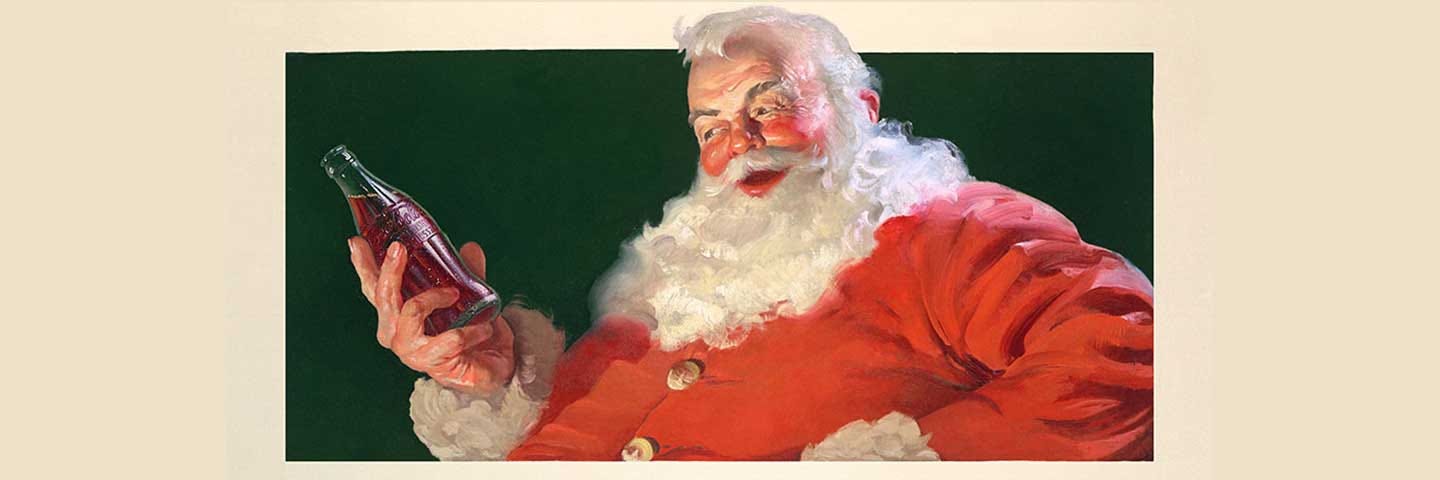
The company’s advertising in this era leaned hard into the imagery of small-town American life. Lee and Robert Woodruff commissioned famous illustrators like Norman Rockwell, N.C. Wyeth, and others, to paint idyllic domestic scenes with it at the centre. In 1931, Coke commissioned artist Haddon Sundblom to create new holiday ads featuring Santa Claus. Sundblom’s Santa was rotund, jovial, and Coca-Cola red from head to toe. The Sundblom Santa popularized and commercialized what became the canonical version of the figure, but the red/white Santa was already common in 19th-century illustration (Thomas Nast in the 1860s–80s) and had been already in use for marketing soft drinks from others. Before then, Santa had been illustrated in various colours; after Sundblom, the red suited version became globally dominant, in because of Coke’s reach.
Coca-Cola’s market position was challenged in the mid-1930s. Pepsi-Cola, a cola company nearly as old as Coke, had struggled for decades — going bankrupt twice and reportedly offering to sell itself to Coca-Cola on three occasions between 1922 and 1934, all declined. Coke always passed the quality benchmark. Pepsi on the opposite end exploited the one feature Coca-Cola had locked into its contracts in terms of the 6.5-ounce bottle and the 5¢ retail price. Pepsi’s response was structural: sell 12 ounces for the same nickel by reusing beer bottles to cut costs. “Twice as much for a nickel too!” became Pepsi’s radio jingle. The positioning was textbook counter-positioning: This is how Pepsi got the attention of budget conscious people including Warren Buffett.
During a March 1st 2010 CNBC Interview on Squawk Box, joined partly with Pepsico’s then CEO, Indra Nooyi, Buffett laid out his thesis on why he used to drink Pepsi and here’s a direct quote (paraphrased slightly for readability):
“I have to say…that I started drinking Pepsi when I was about 6 or 7 years of age in the 30s and if you remember at that time it was twice as much for a nickel too…Pepsi gave you 12 ounces for a nickel and coke gave you 6 and a half ounces. So I would definitely say that at half the price Pepsi was a good buy at that time; marked down 50 percent.” - Warren Buffett
Volume surged and that helped Pepsi survive when most other competitors folded which led to cementing Pepsi’s secondary image as the cheaper cola which stayed around for a while.
US going into World War 2 begun sugar rationing all over and sent millions of American men to go fight. Woodruff treated it as a market-opening event. He committed that every U.S. service member should be able to get a Coke for 5¢ wherever they were, no matter the cost to the Company. They lobbied the government in 1942, arguing that it was essential to troop morale. In a War Department–era exchange cited in Pendergrast, an Army officer wrote that “Coca-Cola could be classified as one of the essential morale-building products for the boys in service.” The government agreed. Coca-Cola was granted priority access to sugar which wasnt necessarily an exemption of the rationing but basically any Coke destined for military bases didn’t count against ration quotas. Coke kept producing near-full capacity, even as civilian candy makers and rival soda brands saw their sugar slashed. Competitors objected; officials brushed it off.
The military went further. Woodruff and Coke’s technical staff were given “Technical Observer” status by General Eisenhower, allowing employees the security clearance to travel with the Army and set up bottling plants on the front lines. Throughout the war the company installed around 64 portable bottling factories across Europe, North Africa, and the Pacific, which had the consumption of more than 5 billion bottles for US service personnel. The funny reception of this was “if anyone were to ask us what we are fighting for, half of us would answer the right to buy Coca-Cola again.” Supplying the troops at 5¢ was unprofitable as wartime sales merely broke even but as Woodruff later assessed, it was probably the largest sampling campaign in its history. Millions worldwide had their first Coca-Cola during the war, opening markets to penetrate organically.
When WW2 ended, Coca-Cola emerged as a global business. Hundreds of bottling outposts remained in countries across Europe and Asia, accelerating the international footprint. Sources say by 1968, half of net profits came from overseas, which started during the war. In the home land, returning veterans came home as durable consumers of the brand. Woodruff’s mantra of making Coca-Cola available “within an arm’s reach of desire” now applied all over the world for the most part.
One of the war’s commercial side products was Fanta. In Germany, the local Coca-Cola operation was cut off from Atlanta during WW2 and could not get Coke syrup. The head of operations there, Max Keith, improvised a soda from available ingredients like fruit pomace — calling it “Fanta” (short for fantasie). After the war, Coca-Cola regained control of the German operations and adopted it. Fanta was introduced into the U.S. market around 1960 and became the first of many Coca-Cola flavor extensions.
By the late 1940s, Coca-Cola was the undisputed market leader at home, an ambassador of American life abroad, and underpinned by an intensely loyal customer base. Woodruff’s conservative strategy of never changing the formula had compounded. The next generation of challenges, however, was already taking shape.
Act V — Post-War Showdown and the Cola Wars (1950s–1985)
Pepsi-Cola was once again close to going bust in the late 1940s. It didn’t benefit from wartime perks, and sugar rationing plus Coke’s dominance left it struggling. The trajectory shifted when Alfred Steele, a former executive at Coke, became Pepsi’s CEO in 1950. Steele scrapped the old playbook. His operating philosophy, captured in his much-quoted line “I don’t care if the consumer wants carbonated sweat in a goat skin pouch. ” was directly contrary to Woodruff’s mindset.
Three opportunities showed up to exploit Coke’s blind spots meaning Pepsi targeted customers Coke had neglected such as African Americans. Rooted in Atlanta’s segregated society, it had largely ignored the market. Pepsi which was based out of New York, hired an all-black sales force focused on their neighborhoods and stores and ran ads featuring African American models/celebrities. The move was very unusual at the time. Second, Steele leaned into an emerging diet/health positioning. Pepsi began marketing itself from 1961 as the lighter, less-filling cola “for those who think young” implicitly casting Coke as the heavy, caloric choice. (Pepsi’s formula was not in fact lighter; if anything it contained even more sugar than coke.) Third, Pepsi embraced television, aiming directly at the youth market. In 1950, Pepsi aired a jingle on TV, and Steele’s team hired a young actor named James Dean for a Pepsi commercial — Dean’s first on-screen role. The “Pepsi Generation” positioning followed.
Close to all of the volume came at Coca-Cola’s expense. Coke still slightly outsold Pepsi, but the margin was narrowing. More importantly, Pepsi was capturing the next-generation consumer base while Coke’s skewed older. The brand was beginning to be looked at as old fashioned in segments where it was dominant before.
Subsequently, Woodruff replaced D’Arcy, the agency that had shaped Coke’s image since the 1920s, with McCann Erickson, which brought a more analytical approach to marketing. One of the first things McCann did was something the Coca-Cola team had not previously attempted but it was smart; A blind taste test between Coca-Cola and Pepsi. The result in late 1957 was that a statistically significant majority of consumers preferred Pepsi. The slightly sweeter Pepsi, with a hint of citrus, won small samplings. Embarrassingly Woodruff ordered the result buried; the test was not to be repeated and the findings were not to be discussed. The secret formula was treated as beyond question. Coca-Cola’s response would be brand mystique, not reformulation.
McCann pushed Coca-Cola onto television and into youth culture. Starting in 1955, the Company became a major sponsor of the Mickey Mouse Club. New slogans replaced “The Pause That Refreshes” whereby “Things Go Better with Coke” became the nationwide campaign by 1963, paired with imagery of modern life improved by a Coke in hand. McCann also broadened the cultural framing. By the early 1960s, Coca-Cola began featuring Black celebrities and Black Americans in its advertising, and signed Olympic gold medalist Jesse Owens, as well as sponsored the Harlem Globetrotters internationally. The shift was late but sufficient enough to dilute the brand’s exclusively white, southern image.
Product diversification followed. The launch of Diet Rite (RC Cola, 1962) and Diet Pepsi (1964) signaled new consumer demand for low-calorie drinks. Woodruff was reluctant. In 1963, Coca-Cola launched TaB, its first diet soda. The name was deliberate: Woodruff refused to allow the Coca-Cola trademark on anything other than the classic formula. An unverified bottler-royalty rumor (a 10¢ per case royalty to Coke’s largest bottler on any drink using “Coca-Cola”) may have reinforced the decision. TaB held the #1 diet position through the 1960s and 1970s, but Diet Pepsi was already building equity in the Pepsi brand within the diet category. Coke was reacting.
Beyond soda, Coca Cola acquired Minute Maid in 1960 which was the first real diversifier aside of carbonated drinks. For decades thereafter, Minute Maid was one of a handful of non-cola assets in the portfolio. (You may know of it under the Cappy brand name in international regions.)
One of the most consequential commercial relationships of the 1950s started without so much as a written contract. In 1955, Ray Kroc was building the first franchised McDonald’s restaurant. A meeting between Kroc and Coca-Cola’s fountain sales executive Waddy Pratt produced a simple agreement: McDonald’s would serve Coca-Cola, and Coca-Cola would treat McDonald’s as a top priority account. The deal was not codified on paper for decades. As McDonald’s scaled across the U.S., it carried Coca-Cola with it. Coke delivered syrup to McDonald’s in stainless-steel tanks (not the usual plastic bags), with pre-chilled lines and a slightly higher syrup ratio — the operational reasons many customers report that “McDonald’s Coke just tastes better.” Coca-Cola also instituted a rule that no other customer could get syrup pricing lower than McDonald’s, even at the cost of losing a sale. When McDonald’s expanded internationally in the 1970s, Coca-Cola helped open foreign markets.
When we take a look at competition around that time, it started to paint a sour picture for coke’s moat. In 1965, Pepsi merged with Frito-Lay to form the diversified PepsiCo we know of today. The deal gave PepsiCo a profitable snacks business, a steady cash generator that would fund the battle against Coke for decades on end. Coca-Cola reportedly had the option to acquire Frito-Lay (the snack maker was based in Dallas and was open to a Coke offer) but passed. Coming into the 2000s, sources say that Frito-Lay was contributing more than half of PepsiCo’s profits. The miss is conventionally cited as one of Coca-Cola’s most consequential strategic errors of the 20th century.
Entering the 1960s, brand momentum had partially reversed. In 1969, Coke launched “It’s the Real Thing,” a counterculture-aware authenticity positioning. 2 years later networks aired what would become one of the most-cited television ads ever: the “Hilltop” commercial. A multicultural group of young people sang “I’d like to buy the world a Coke, and keep it company” on a hilltop in Italy. Suffice it to say that the ad had staying power; 40 years later, Mad Men used it in its series finale and featured in one of Warren Buffett’s documentaries.
Internally, leadership was aging. Robert Woodruff, who had run Coca-Cola since 1923, was in his 80s by 1970 and resistant to changes that might disturb the legacy. Day-to-day control sat with CEO J. Paul Austin, but by the mid-1970s Austin was struggling with health issues; rumors say that it had to do with early Alzheimer’s. The combination produced a multi-year decision vacuum at the top, the period in which Pepsi launched the Pepsi Challenge.
In 1975, Pepsi launched the Pepsi Challenge — a nationwide campaign in which consumers in shopping malls were blind-tasted between Pepsi and Coke. Footage of surprised consumers preferring Pepsi was used in television advertising. The campaign leveraged exactly what Coca-Cola had known internally since 1957 but refused to initiate dialogue. Coca-Cola’s response was muted. Through the late 1970s, leadership inertia held; Woodruff was unwilling to change the formula or the image in response to what he viewed as a marketing gimmick. From 1975 to the mid-1980s, Coca-Cola’s U.S. market share declined each year while Pepsi’s grew. Coca-Cola was still ahead, but the gap was closing.
The old guard stepped aside at the start of the 1980s. Austin retired in 1981 after the company requested he stay another year; Woodruff died on March 7, 1985. The Cuban-born Roberto Goizueta took the transitional helm in August 1980 with a completely different operating mandate, including the New Coke decision that would become one of the most-discussed marketing episodes of the decade. He would later replace Austin as Chairman/CEO after his resignation.
Act VI — Coca-Cola Classic Strikes Back (1985–2005)
Management in April 1985 made the decision to change the century-old formula, launching “New Coke.” The public reaction was swift and overwhelmingly negative. It took less than a quarter for Coca-Cola to reverse course. On July 11, 1985, President Don Keough and Goizueta announced the return of the original formula as Coca-Cola Classic. The line that survived was “Some critics will say Coca-Cola has made a marketing mistake. Some cynics will say we have planned the whole thing. The truth is we are not that dumb, and we are not that smart.” The company maintained that it had not been a stunt, only a misjudgment. The reaction once Classic returned was unambiguous: consumers shifted back en masse, and New Coke (rebranded “Coke II”) limped along. Classic’s market share exceeded its pre-debacle level a year later. The episode functioned as an accidental publicity event that effectively neutralized the Pepsi Challenge as a marketing weapon.
Berkshire Hathaway built its Coca-Cola position between 1988 and 1994 at a cumulative cost basis of approximately $1.299 billion (about $3.25 per split-adjusted share). The 400 million shares represented roughly 7% of the company at the time and approximately 9.3% as of early 2026; Berkshire has not sold a share since 1994. At the early-May 2026 share price of roughly $78.50 ( when we started working on this piece), the stake is worth approximately $31.4 billion. On the dividend rate that took effect with the Feb 2026 raise to $0.53 quarterly ($2.12 annualized) — the 64th consecutive annual increase — the position generates approximately $848 million per year in cash income, a roughly 65% yield on Berkshire’s original cost basis. Cumulative dividends received from 1994 through 2025 total approximately $11.7 billion against the $1.299 billion cost. With dividends reinvested, the structural advantage of the Berkshire holding was the ability to redeploy the dividend cash stream at high incremental returns elsewhere in the holding company.
But that aside, back to the evolution. The late 1980s also brought a marketing reset. Coca-Cola’s entertainment detour (Columbia Pictures, acquired 1982) ended in 1989 with Columbia’s sale to Sony, a deal on which Michael Ovitz’s Creative Artists Agency advised. Ovitz subsequently pitched CAA to take over Coca-Cola’s advertising account from McCann Erickson, arguing that the era of a single iconic ad was over and that the fragmented 1990s media landscape required many targeted messages.
CAA sort of replaced a portion of McCann’s mandate and launched “Always Coca-Cola” in 1993 though. The polar bear Christmas campaign that followed entered the brand’s permanent iconography.
Underneath the advertising, a larger shift was underway: consumer tastes were drifting away from sugary colas. The first battleground was sports drinks, where Gatorade had effectively created the category in the 1960s, was acquired by Quaker Oats in 1983 and scaled it from there on. Coca-Cola launched Powerade in 1988, but it didn’t stand up against Gatorade and played catch up against its first movers advantage.
By the late 1990s, the flagship and its diet variants were still growing, but non-carbonated categories (sports drinks, bottled water, teas, juices, energy drinks, coffee) were capturing more growth. Health consciousness was rising, and full-sugar soda was increasingly identified as a contributor to the obesity epidemic. (A 12-oz Coke contains 39g of sugar; the American Heart Association’s recommended daily added-sugar limit is roughly 36g for men and 25g for women.) The core product was an exceptionally profitable cash engine that was increasingly framed as a public-health concern. It of course could not abandon it but had to invest around that concern. How to diversify away from the product on which the brand identity was built, without ceding that the product was “bad for you,” would frame Coca-Cola’s strategic discussions for the next two decades.
The first material test came at the turn of the millennium. In November 2000, 9 months after becoming Coca-Cola’s chairman and CEO, Douglas Daft pursued an approximately $15.75 billion all-stock acquisition of Quaker Oats, principally to obtain its dominant Gatorade franchise. The executive committee had authorized Daft to explore a possible transaction, and the company publicly confirmed that discussions were underway but the negotiated deal still needed approval from the full board. Although Daft and Quaker’s management appeared to expect ratification the board rejected the proposed terms after hours or meeting, principally because it considered the price too high.
Warren Buffett, then a director, was reported to have serious reservations about the economics of the transaction. After the announcement, shares actually rose showing the broader shareholder base’s opinion to the saga and preferred outcome. Below is a quote block I pulled directly off of a CNBC Interview Warren Buffett gave in 2014:
“Well, it got very public and basically the management sort of let the world know that Coca-Cola was buying Quaker Oats. And there was a meeting rather hastily called in New York, and directors went into that room.
And I was not the first one to say that giving away 11 percent or so of the Coca-Cola Company to obtain Gatorade primarily, although a bunch of other foods came with it. But Coca-Cola really didn’t want the foods, they wanted Gatorade.
We thought the first proposed opposition to it, I should say, said he didn’t think that mathematically made sense, to giveaway 11 percent of Coca-Cola to get a single product, Gatorade.
I had come into the meeting feeling the same way. I just didn’t speak first in that case. Then I spoke, and by the time I got through, the deal did not go through.”
-Source: Warren Buffett to Becky Quick of CNBC (May 5th 2014, Squawk Box)
PepsiCo then acquired Quaker Oats in 2001 for around $13.8 billion which led way to owning both the leading sports drink and (via Frito-Lay) a snacks portfolio that would soon generate more than half of the entire group’s profits. Coca-Cola had neither.
The Gatorade episode coincided with broader organizational churn. After Goizueta’s death, Coca-Cola cycled through 3 CEOs. Ivester, Daft, then Isdell, each lasting only a couple of years. The continuity of earlier eras did not return until Mukhtar Kent’s tenure.
Coke pushed into adjacent categories with bottled water with Dasani in 1999, around 5 years after Pepsi’s Aquafina. It introduced new soft drink variants (Cherry Coke in 1985, Vanilla Coke in 2002) and Diet Coke (launched 1982) became the #2 soda in the US. Acquisitions were selective: Odwalla in 2001, Glacéau Vitaminwater and Fuze Tea in 2007. Coca-Cola’s default approach in adjacencies became fast-following: let an upstart prove a category, then enter through Coca-Cola’s distribution and marketing scale. This worked unevenly. The energy-drink category was the miss though…Red Bull pioneered it in the late 1990s; Hansen’s (later Monster) was gaining traction in the early 2000s; Coca-Cola could have acquired Monster while it was still subscale, but did not. By the time Coke seriously engaged with Monster around 2011, the price had moved beyond what management was willing to pay. The 16.7% stake for $2.15B was concluded in 2014.
Act VII — The Total Beverage Company Era (2005–2024)
As the new millennium came to fruition, growth was slowing. Health consciousness was rising, soda consumption in core markets was flat, and PepsiCo had diversified well beyond cola. Coca-Cola faced the paradox of executing a “total beverage company” strategy while Classic Coke, Diet Coke, and Coke Zero remained the dominant economic engines.
Coca-Cola’s future shifted decisively outside the United States. Coke had the battle against competitors, at the cost of saturation. The majority of its revenue and profit was generated outside the US. Asia, Latin America, and Africa became the principal growth contributors, and the post-WWII strategy of planting locally owned bottlers in every country compounded into a structural advantage. In each market, Coke’s products generate local jobs and profits, which positions the brand as locally embedded rather than imported.
The internationality of Coca-Cola provides a certain extent of diversification if you’re a buyer of the company. It is, through its operations, diversified across geographies, revenue mix, etc…you get the idea.
Coke also expanded aggressively into still beverages and new categories. The 2000s saw a flurry of acquisitions: Vitaminwater (Glacéau) in 2007 for $4.1 billion; big stakes in fairlife dairy and Innocent smoothies. In 2014, Coca-Cola took a 16.7% stake in Monster Beverage for $2.15 billion, swapping its own energy drink brands under Monster’s management. In 2018, Coke announced its £3.9 billion ($5.1 billion) acquisition of Costa Coffee. The transaction closed in the beginning of 2019 at around $4.9 billion after FX adjustments. The same mentality led to acquiring BodyArmor (the now late Kobe Bryant’s backed sports drink) in 2021 for $5.6 billion. By 2020, Coca-Cola’s portfolio had grown into the hundreds of brands, and thousands of products worldwide on the company’s own count.
Had Coke spread itself too thin? James Quincey the CEO as of 2017 concluded that the answer was yes. In 2020 covid forced strategic resets across consumer companies and shut down roughly 200 underperforming brands and effectively halving the line-up. Legacy names including TaB (Coke’s first diet cola) and niche products like ZICO coconut water, Odwalla juices, and Honest Tea were discontinued (ZICO sunsetted in 2020 and discontinued in late 2022, and Odwalla in 2020 decisively). Coca-Cola wanted to focus on “master brands” that could scale globally. Even then, the company still had 30 brands generating over $1 billion in annual revenue each, about half created organically, half via acquisitions.
The 2005–2024 period was characterized by adjacency expansion and bottling reorganization rather than core-brand reinvention. Interbrand’s 2024 ranking placed Coca-Cola at #7 globally, the highest-ranked FMCG brand. The company’s objectives were simple during the phase: Protect the core, manage the portfolio, re-franchise the bottling, return cash.
The System: Bottlers, Incentives, and Global Scale
In 1986, it orchestrated a major consolidation, combining a group of company-owned and large independent bottlers to form Coca-Cola Enterprises (CCE) — a publicly traded entity that became the largest Coke bottler in the world. Through CCE (and later other regional anchors), Coca-Cola gained greater control over distribution. Crucially, U.S. antitrust law was amended in 1980 thanks to the Soft Drink Interbrand Competition Act signed by President Carter on July 9, 1980 to explicitly permit exclusive territories for soft drink bottlers. This meant Coke could grant local bottlers monopoly rights which allowed it to corner the market in each region with aligned partners. Once a local bottler was in the system, they had little incentive (or even ability) to carry competitors’ products. Bottlers were handed durable local-monopoly economics for as long as they grew Coke sales, and the alignment proved structurally durable. Robert Woodruff’s mantra — “everyone who touches Coca-Cola should make money” — gave Coke a permanent advantage in availability and shelf space worldwide.
The term “The Coca-Cola System” came about a decade or two ago, because the company owned only a few bottlers outright; most were independent. While system-wide retail sales were enormous (well over $100 billion), the parent company’s reported revenues were a fraction of that — essentially concentrate sales and licensing fees. On FY2024 figures, the parent’s net revenues of $45.8 billion sat against a far larger combined Coca-Cola system retail value (the company’s own framing places system retail value in the high-$100-billion range, though the precise aggregate is not a disclosed accounting figure). The parent captures roughly a quarter of system revenue and the majority of system profit, on perhaps 10% of the system’s workforce. The bottlers absorbed the heavy capital investment and the low-double-digit operating margins; the parent retained the high-margin concentrate and brand-royalty income — gross margins above 60%, comparable operating margins in the high-20s. A cloned formula would not, on its own, get a competitor anywhere: the distribution and the scale economies are the actual moat, and neither is replicable on a relevant timeframe.
The Brand-Scale Flywheel
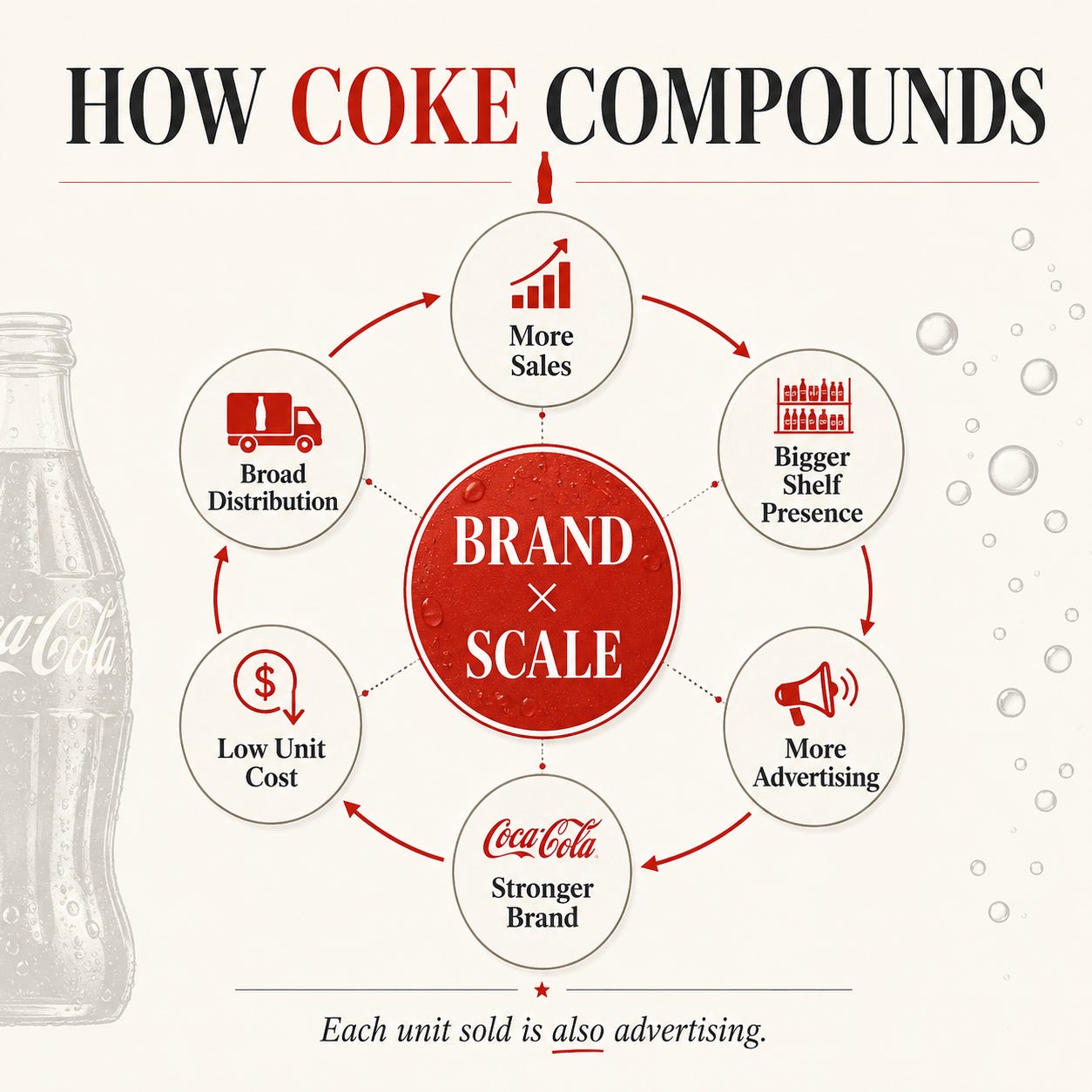
Through every era of the company’s history, the competitive engine has been the interplay of brand and scale. The more Coke sold, the more it could invest in advertising and distribution, which reinforced the brand and enabled more sales, and so on...
Unlike luxury brands or premium tech, it doesn’t depend on charging a premium price; soft drink pricing is restrained. Brand strength shows up in ubiquity and volume rather than ASP. Each unit on a shelf is also a unit of advertising, and the Company wants billions of those units circulating. Coca-Cola plows brand equity into keeping prices low and availability high, rather than extracting it through price increases. The result is a flywheel: scale enables high absolute ad spending and low unit costs, which yields more sales and more scale. By the 2000s, Coca-Cola’s annual marketing budget had reached the multi-billion range, an order of magnitude above any beverage competitor outside PepsiCo. PepsiCo had achieved rough parity in market share by the late 1970s; the cola wars of the 1970s and 1980s nonetheless ended with Coca-Cola’s installed brand loyalty intact.
Modern Refranchising and Capital Allocation
Underneath the brand work, Coca-Cola continued to lean into its asset-light concentrate model and the bottling system that had always defined it. In the 2010s, the company restructured and re-franchised its bottling operations worldwide. Also the company re-acquired its largest bottler (Coca-Cola Enterprises’ North America operations) via a quasi-cashless transaction; the deal value consisted of Coca-Cola's existing ~34% equity stake in CCE (~$3.4B) plus assumption of $8.88B of CCE debt, structured as a substantially cashless transaction with which the acquisition was an unusual step aimed at improving quality and efficiency. Over the next several years, it then spun those bottling assets back out to new owners once the operations were streamlined. Coca-Cola pushed bottling partners to consolidate, achieving scale and uniform standards, and finally shed the last remnants of archaic “parent bottler” arrangements. By the late 2010s, the company was largely through this refranchising, returning to an asset-light, pure concentrate company globally. The result: Coca-Cola could serve the entire world with a handful of syrup plants, while heavy capital investment of bottling and distribution remained off its balance sheet. As one observer put it, “you’d much rather be Coca-Cola than the bottlers.”
Financially, Coca-Cola’s profile evolved from a high-growth story into a classic cash cow and dividend aristocrat. Net revenues roughly doubled from about $23 billion in 2005 to $47 billion in 2024 which was reasonable compound growth, given the mature nature of soda and the push/pull of re-franchising. Coke leaned on pricing power to drive growth in a period of flat volume in many markets. In 2022 and 2023, Coca-Cola produced organic revenue growth of +16% and +12% respectively, with the bulk of the lift coming from price/mix rather than volume. The 2024 print of +12% organic revenue continued the pattern; the 2025 print of +5% (price/mix +4%, volume +1%) marks the first material deceleration of the post-pandemic pricing run. With limited reinvestment opportunities in the core soda business, Coke leaned heavily toward shareholder returns. The company has increased its annual dividend for 64 consecutive years through the February 2026 raise and historically supplements the dividend with share buybacks although the intensity of repurchases has fluctuated, dropping from $2.3 billion in 2023 to $746 million in 2025 as the dividend has absorbed a larger share of free cash flow. Excess cash has also funded acquisitions into new categories so that they can grow externally when internal growth is hard to come by.
3. Big Moves
The “Big Moves” section is included as a visual map rather than repeated in full below. The framework is intentionally repetitive — Decision, Tradeoff, Second-Order Effect, and “Tell” Metric — so the image is a cleaner way for subscribers to save, revisit, and study KO’s evolution over time.

4. Moats & Fragilities (Present-Day Assessment, 2026)
What follows is a consolidated assessment of where Coca-Cola’s competitive position stands as of the spring of 2026, after 140 years of existence. Each moat and fragility references the Acts only where the historical mechanism is essential to understand the current state.
Moats
Brand power and emotional resonance. Coca-Cola’s brand is its single most valuable asset. Interbrand’s 2024 Best Global Brands list ranked Coca-Cola #7, the highest-ranked FMCG brand in the world. The depth of the loyalty was demonstrated when the formula changed in 1985 (see Act VI): consumers treated it as a betrayal and demanded “their” Coke back. Even when blind taste tests don’t favor Coke (as McCann found internally in 1957 and Pepsi later weaponized in 1975 — see Act V), the brand halo often makes consumers perceive it as superior. The asset is reinforced rather than depreciated: Coca-Cola’s reported advertising expense has run around $5 billion and rising ($5.1B in 2024 and roughly $5.4B in 2025 per its 10-K), and the company has sponsored events from the Olympics to FIFA World Cups and its century-long Times Square billboard. New competitors find it extremely hard to win over Coke’s loyalists which includes yours truly, and retailers need to stock Coca-Cola products to satisfy consumer demand.
Unmatched distribution network. Coca-Cola’s distribution system reaches retail outlets in over 200 countries through around 225 bottling partners. The reach creates a scale moat that a new beverage company, however well-marketed, cannot reasonably replicate on any commercial timeframe. Coke’s products are “within an arm’s reach of desire” - Robert Woodruff’s stated goal a century ago. The network effect is self-reinforcing: the more consumers ask for Coke, the more retailers stock it, which makes it more ubiquitous. The 1980 federal antitrust amendment permitting exclusive territories for soft drink bottlers (see Act VI / Big Move 14) gives Coke’s partners local monopolies and locks out competitors at the bottling level. Coca-Cola has entrenched partnerships with restaurants (e.g., the McDonald’s handshake of 1955 — see Big Move 9), stadiums, amusement parks, airlines, and universities. Coca-Cola executives have repeatedly framed the moat in distribution rather than formula terms: a cloned syrup recipe is the easy part; the hard part — the scale economies of getting the finished drink in front of two-billion-plus daily occasions — is not for sale.
Asset-light economics. Coca-Cola’s concentrate model yields gross margins typically in the 60%+ range and comparable (non-GAAP) operating margins around 30%; reported GAAP margin sits in the low-to-mid 20s after one-time charges. The company makes syrup at low capital intensity while bottling partners absorb the heavy capital requirement of plants and trucks. Coke’s reported revenue (~$47B) is roughly 27% of the combined revenue of all Coca-Cola system entities (an estimated ~$170–180B gross, with concentrate syrup double-counted).
The structural economics give Coca-Cola pricing flexibility, the ability to outspend rivals on marketing or innovation, and the cash to acquire promising brands when internal innovation stalls.
Pricing power. Coca-Cola posted organic revenue growth of approximately +16% in 2022, +12% in 2023, and +12% in 2024 — the bulk of the lift coming from price/mix rather than volume. Consumers largely accepted the increases. This is the moat in operation: the ability to pass on cost increases without losing meaningful volume. The 2025 deceleration to +5% organic revenue (price/mix +4%, concentrate sales +1%) was the first material moderation of the post-pandemic pricing run, with Q4 2025 specifically showing a reversal in mix (concentrate sales +4%, price/mix +1%). The Q1 2026 print; organic revenue +10%, driven by concentrate sales +8% (boosted by six extra selling days) and price/mix +2%, with underlying unit case volume up ~3%. suggests the moat held: when price/mix moderated, volume re-accelerated. Pricing power, however, is not unlimited; Coca-Cola has rolled out smaller pack sizes (the U.S. mini-can program announced October 2025 is one example) to retain price-sensitive consumers.
Aligned ecosystem incentives. Coca-Cola has engineered an ecosystem in which a vast array of businesses profit from its product’s success. Bottling partners with exclusive territories have every reason to push Coke into more outlets. Big fast-food chains (McDonald’s preeminently) get favorable syrup pricing that boosts their soft drink margins. Convenience stores rely on Coke-funded fridges and displays. As Woodruff put it, “everyone who touches Coca-Cola makes money.” It is hard for a competitor to break in when the entire value chain is rooting (financially) for Coke.
Regulatory and supply chain mastery. Coca-Cola benefits from a unique DEA arrangement: its supplier Stepan Company is the only U.S. entity licensed to import and de-cocainize coca leaf (a legacy of its formula). More practically, scale gives it efficient sourcing of sweeteners, packaging, and aluminum, and long-term supplier relationships that smaller rivals can’t match. Coca-Cola’s deep experience operating in diverse jurisdictions gives it a regulatory moat — it knows how to comply, influence, or adapt to legal changes faster than new entrants.
Fragilities
Health and dietary backlash. This is the single biggest long-term challenge, and it is the one thing that worries me the most in terms of Coca-Cola, especially after the MAHA (Make America Healthy Again) initiative. A 12-ounce Coke contains 39 grams of sugar, more than the American Heart Association’s daily limit for adults. Per capita carbonated soft drink consumption in the U.S. has declined roughly every year since 2004, reaching a roughly 30-year low in 2015 (lowest since 1985) and continuing to decline. Sugar taxes (Mexico, parts of Europe, several U.S. cities) have already dented sales. Young consumers increasingly gravitate toward flavored waters, teas, and functional drinks. Coca-Cola’s identity and expertise are tied to selling sweetness for enjoyment — and the very attributes that made Coke profitable (sweet, cheap calories) are the ones now under public-health pressure. Even after years of diversification, sparkling soft drinks remain the substantial majority of company volume. The Coke Zero / Coke Zero Sugar response (see Big Move 17) is buying time, but the secular trend is real. People are becoming much more self aware dietarily and that hurts Coke’s flagship product lines over time.
Single-product dependence. The group of trademarks for the term “Coca-Cola” (Classic, Diet, Zero Sugar) accounts for 47% of worldwide volume (sparkling overall is 69%). The New Coke episode showed how tied the company’s identity is to one formula. Coca-Cola is, in strategic terms, still selling 19th-century sugar water as its primary cash engine — and as growth in that category stalls, the company’s fortunes can stall too unless new hits emerge.
Late-mover pattern in adjacencies. A recurring critique through the 1990s and 2000s: Coca-Cola often reacted slowly to market shifts. Late to bottled water (Dasani came five years after Aquafina). Late to energy drinks (dismissed Red Bull and Monster until prices rose dramatically). Late to sports drinks (the Gatorade miss in 2000 — see Big Move 16 — forced the $5.6 billion BodyArmor acquisition two decades later). Coca-Cola’s conservatism, born of decades of cola dominance, has historically made it reluctant to cannibalise its own sales or pay early-stage prices for emerging-category brands. The cost has been arriving late and writing larger cheques later.
Bottler dependency. The franchised model is a moat but also a vulnerability. If a major bottler encounters financial trouble, labor disputes, or fails to maintain quality, the brand suffers. Strategic misalignment is a perennial issue: bottlers want volume; Coca-Cola Company sometimes prioritizes margin or brand image. Bottler consolidation has helped (CCEP in Europe, Coke Consolidated in the U.S.), but a disruption at a major one could affect entire regions. Coca-Cola is not vertically integrated; it must lead through influence, which is generally a strength but a fragility when alignment breaks down.
Regulatory and ESG exposure. Coca-Cola is one of the largest producers of plastic bottles in the world. Plastic pollution regulation could force costly packaging changes. Water usage is another concern — as the world’s largest beverage company, Coke depends on reliable water sources, and in water-scarce regions this can become a flashpoint. Marketing sugary drinks to children invites restrictions. The ESG profile is structurally exposed.
Competition and alternative beverages. Coca-Cola and PepsiCo share a stable cola duopoly, but the picture is more contested in adjacent categories: Red Bull and Monster in energy, Starbucks and JAB in coffee, Nestlé and others in water. PepsiCo's total revenue is nearly double Coca-Cola's (~$92B vs ~$47B), driven by its snacks business (Frito-Lay), which gives it retailer bundling leverage Coca-Cola lacks.
Store brands and independents continue to take share in pockets (LaCroix in sparkling water, kombucha brands, premium juices). Coca-Cola’s response has been acquisitive (Topo Chico, fairlife, BodyArmor, Costa, Vitamin Water to name a few…); the structural risk is not any single competitor but cumulative share loss across many fronts.
Limited organic growth runway. Coca-Cola’s core business is so penetrated globally that organic growth is inherently limited to population growth and slight per-capita increases (mostly in developing markets). The story is “penetration plus pricing,” not a volume boom. If emerging markets like China or India fail to deliver the per-capita gains Coke hopes for, the company hits a ceiling on volume. The recent reliance on price/mix to drive 10%+ organic revenue growth is unrepeatable indefinitely. A manageable problem though.
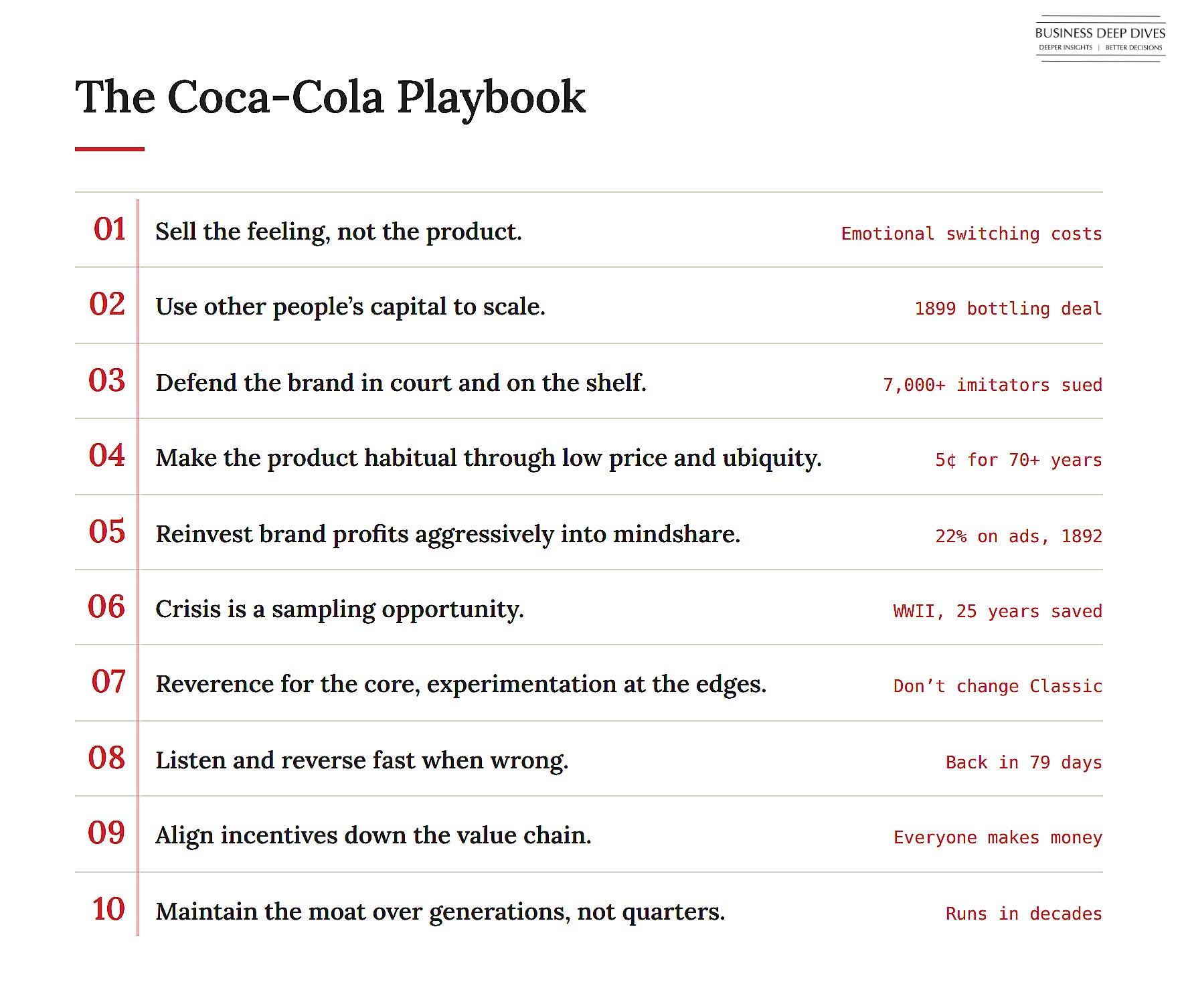
The Coca-Cola Playbook
Ten principles — distilled from the Acts and the Big Moves — that explain how Coca-Cola became Coca-Cola. Each is a stated principle plus a brief pointer to where it shows up in the Acts.
1. Sell the feeling, not the product. Coca-Cola’s mid-1920s shift from medicinal claims to lifestyle advertising and slogans like “The Pause That Refreshes,” the Sundblom’s Santa, then “Hilltop” built emotional switching costs that competitors selling “just a cola” could never replicate. (See Acts III–V; Big Moves 6, 7, 11.)
2. Use other people’s capital to scale. The 1899 bottling deal let the company blanket America with a really small employee base at the head office. Franchisees built the plants and trucks; Coke kept the margin. (See Act II; Big Move 4.)
3. Defend the brand in court and on the shelf. Trademark, secret formula, and the 1916 contour bottle gave Coke a triple-layered moat (things like the name, taste, look etc…) that outlived expiring patents. Over 7,000 imitators reportedly sued out by the mid-1920s; near-universal bottle-shape recognition by 1949 (Coca-Cola study). (See Act III; Big Move 5.)
4. Make the product habitual through low price and ubiquity. A 5¢ price held for 70+ years; “within an arm’s reach of desire” as the distribution mantra. Habit-forming products such as caffeine, sugar, easy access produce recurring usage that dwarfs occasional purchase. (See Acts I–IV; Big Moves 1, 4, 8.)
5. Reinvest brand profits aggressively into mindshare. Spending 22% of revenue on advertising in 1892 was extreme by the standards of the time; the absolute spend remains in the multi-billion range. When unit economics are as fat as Coke’s, the best use of profit is buying mental availability before a serious rival can. (See Acts II–IV; Big Moves 3, 6.)
6. Crisis is a sampling opportunity. The WWII commitment to ship Coke to every soldier at 5¢ broke even in the short run and opened markets that would have taken 25 years and untold millions to penetrate organically. Coca-Cola’s modern global footprint was built on a wartime loss leader. (See Act IV; Big Move 8.)
7. Reverence for the core, experimentation at the edges. Don’t change the flagship formula (the New Coke episode is the cautionary tale); innovate around it. Diet Coke (1982), Coke Zero (2005), Cherry Coke, Vanilla Coke, mini-cans, glass bottles extensions live alongside Classic without dilution. (See Acts V–VII; Big Moves 10, 13, 17.)
8. Listen and reverse fast when wrong. New Coke launched in April 1985; Coca-Cola Classic was back in 79 days. Public admission of error, restoration of the original formula. Customer loyalty deepened and the mess up showed itself as an accidental publicity event that destroyed the Pepsi Challenge. (See Act VI; Big Move 13.)
9. Align incentives down the value chain. Woodruff’s mantra: “Everyone who touches Coca-Cola should make money.” Bottlers with exclusive territories, McDonald’s with preferential pricing no other customer beats, retailers with funded coolers — every link of the chain is rooting financially for Coke. (See Acts II, V; Big Moves 4, 9, 14.)
10. Maintain the moat over generations, not quarters. Coca-Cola’s strategic clock runs in decades. The trademark war against imitators ran in the ballpark of 20 years, capped by the 1920 “Koke” Supreme Court win. The bottling system took 30 years to mature, and the postwar global footprint took a generation. The ESG, health-trend, and refranchising challenges of the 2020s are being addressed on the same patient timescale. (See Acts III, IV, VII; Big Moves 5, 8, 18.)
Quintessence — Scale and Intimacy
The most distinctive thing about Coca-Cola, and the part of the business that is hardest to replicate, is that scale and intimacy were never traded against each other. The conventional intuition is that a company gets large by sanding off the specifics; the local quirks, the personal connection, the texture of the original product — until what remains is generic enough to be sold everywhere. Coca-Cola did the opposite. It scaled the specifics. In most recent disclosures, its products reached more than 200 countries, 200 bottling partners and accounted for roughly 2.2 billion daily servings worldwide (ballpark figures); over the same span, the Company spent billions a year reinforcing emotional associations attached to one closely guarded formula, and the contour shape.
The mechanism is the franchise system. Robert Woodruff’s mantra — “I want everybody associated with Coca-Cola to make money” — is usually quoted as folk wisdom, but the operational consequence is precise. A bottler with an exclusive territory has every commercial reason to behave as though it were a local business: stocking the corner store, sponsoring the local high-school team, hiring the local route driver, defending the local price point. The Coca-Cola Company does not run those outlets. It does not need to. It supplies the syrup, defines the brand, and collects roughly a quarter of system revenue and the majority of system profit while owning roughly 10% of system headcount. The 1980 Soft Drink Interbrand Competition Act, signed by President Carter on July 9, 1980 (Pub. L. 96-308), codified exclusive territories under U.S. antitrust law and locked in the local-monopoly economics that make this alignment durable rather than aspirational. The brand engine works on the same logic: a 1931 Sundblom Santa, a 1971 Hilltop, a Polar Bear ad — global pieces of communication that nonetheless feel personal because the artifact at the centre is the same in Atlanta and Auckland and Abuja. The marketing system spends to keep the artefact universal; the bottling system distributes it locally. The 1899 Thomas–Whitehead bottling contract, the 1916 contour bottle, the 1955 McDonald’s handshake, the 1980 antitrust statute, and the 2010s refranchising programme are not separate stories. They are five layers of the same architecture: scale at the centre, intimacy at the edge, with a fixed allocation of margin between the two that has held for over a century.
Most large consumer companies face a trade-off between growth and capital efficiency: the first dollar of revenue is fat, the marginal dollar gets thinner as distribution expands and the brand has to fight harder for shelf space. Coca-Cola, by separating the brand-and-syrup business from the plant-and-truck business, held the parent company’s gross margin around the 60% range even as system retail value passed an estimated $150 billion (an analyst’s estimate). The cost of the architecture is borne by the bottlers, where operating margins sit closer to 13%…still attractive, but a different business. The benefit accrues to the parent. This is the single most important fact about Coca-Cola’s financial profile, and it is a direct consequence of decisions made between 1899 and 1916, before the underlying products were globalized. Most modern moats are network effects engineered in software. Coca-Cola’s is a contractual architecture engineered on paper and renewed every time the bottling system is reorganized.
Coca-Cola’s quintessence, then, is the architectural insight that scale and intimacy can be engineered to reinforce each other, encoded into contracts and capital structures and product specifications that survive succession and cycle. Most companies eventually have to choose. Coca-Cola, for 140 years, has not.
The View
This section is the author’s working judgement on Coca-Cola as it stands in the spring of 2026. It does not replace the qualitative or quantitative analysis that precedes it; it puts a position on the table.
Is this still a wonderful business?
Of course it is, with two narrowings that are visible in the data.
The parts of the moat that are unambiguously intact are the ones the qualitative sections of this report have walked through at length. The brand is not in retreat; Coca-Cola was the seventh-most valuable brand in the Interbrand 2024 ranking, the highest-ranked FMCG brand in the world. The distribution system reaches more than 200 countries each with at least one bottling partner and roughly 2.2 billion daily servings, an asset that simply cannot be reconstructed by a new entrant. The concentrate-model economics still produce gross margins above 60% and operating margins, on a comparable basis, in the high-20s — twice the operating margin of the largest publicly traded bottlers, which is the financial signature of a genuine asset-light moat.
Two things worth bringing up…The first is the health-and-sweetener narrowing: the secular trend in developed-market per-capita carbonated soft drink consumption has been negative for roughly two decades, and the company’s own 30+billion dollar brand portfolio still has Trademark Coca-Cola at its volume centre. The diversification helps but does not solve the underlying drift. The second is the late-mover narrowing in adjacencies: the Gatorade miss cost the company structural participation in sports drinks, the Red Bull / Monster reaction came late, and the company’s pattern through the 2010s and 2020s has been to write large cheques (Costa $5.1bn, BodyArmor remainder $5.6bn) for category leaders that it chose to buy rather than build in these adjacencies. Both are visible in the financials. Both are real. Neither, in our view, is yet existential.
The unresolved tension on sugar
The honest framing is this: Coca-Cola’s identity is sweetness. The company’s flagship product, the source of its global brand recognition, the contour bottle, the Sundblom Santa, the Hilltop ad, “Always Coca-Cola” — all of it descends from a 5¢ glass of sweet, caffeinated water. Developed-market consumers, especially the younger cohort, are drifting away from sweetness and the regulatory environment (sugar taxes in Mexico, parts of Europe, several U.S. cities) is reinforcing that drift.
The company’s answer to date has been the Trademark Coca-Cola portfolio strategy: Coke Zero Sugar (which now grows faster than Classic in most developed markets), Diet Coke, and ongoing reformulation work. Even though It bought the company time, it doesn’t resolve the tension but more so manages it. To actually solve it, Coca-Cola would need to do one of two things. Either the underlying per-capita sweetness drift would have to stabilize — which is plausible, since the no-/low-sugar option is now genuinely good and represents an increasing share of the volume mix — or the company would need to become genuinely category-agnostic, with material profit pools outside sparkling soft drinks.
The Costa Coffee acquisition was an attempt at the second route. So was BodyArmor. Whether either has worked to the standard required is, we think, still open. Costa is a multi-format business that includes thousands of UK retail cafés, and the unit economics of running cafés are nothing like the unit economics of selling syrup. Coca-Cola was already the clear #2 company in sports drinks through Powerade. The $5.6bn BodyArmor deal aimed to strengthen the position with a premium brand and eventually challenge Gatorade for the first spot. It hasn't worked out as hoped: BodyArmor slipped back behind Powerade to #3 and Coca-Cola has written down roughly $1.7bn on the brand, but the combo of Powerade and BodyArmor is still meaningfully behind Gatorade. We are not yet persuaded that either deal has closed the strategic gap they were intended to close. They have, however, proven the company is willing to pay up for category leaders rather than try to incubate them — which is the more honest read of a business with strong distribution and weaker brand-building muscle in non-cola categories than its own self-image suggests.
The pricing-power question
Three years of double-digit organic revenue growth 2022-2024 were driven almost entirely by price/mix. In 2024, roughly five percentage points of the +11% full-year price/mix print came from hyper inflationary markets (mostly Argentina). That contribution is not pricing power in the durable sense; it is FX-and-inflation pass-through that will normalize as comparison bases roll. The 2025 deceleration to +4% price/mix and +1% volume (concentrate sales) — with management explicitly attributing some of the Q4 softness to “unfavourable mix” — is the first data point that suggests the elasticity bound is becoming visible.
The right framing is probably this: Coca-Cola’s pricing power is not symmetric. The company can pass on cost increases more efficiently than nearly any beverage peer, because of the brand and the bottler-aligned incentive structure. But it cannot keep extracting price/mix at +9% indefinitely without risking volume — particularly in markets where smaller pack sizes have already been rolled out as the affordability lever (the U.S. mini-can program announced October 2025 is one example). Our base-case view is that the durable run-rate for organic revenue, going forward, is something closer to +4% to +6% — roughly in line with the company’s own long-term framework — rather than the +12% to +16% that 2022–2024 produced. Anyone modelling forward returns on the recent three-year cadence is modelling a temporary peak, not a steady state.
What would change my mind
The bull case needed to upgrade. Genuine volume re-acceleration in developed markets, particularly North America, sustained over more than two quarters and not dependent on hyperinflation pass-through. Evidence that Costa can be stabilized and made profitable — not sold — after the aborted 2025–26 disposal, with the canned RTD line scaling independently. Evidence that BodyArmor is gaining share against Gatorade rather than splitting the rest of the category with Powerade. A successful recent proprietary launch at scale — the last decade's non-sparkling wins have all been acquired. None of these is impossible; none has yet happened with the scale that would shift the long-term return profile.
The bear case that would break the thesis. A meaningful, durable acceleration in the per-capita sweetness drift in developed markets, driven by either a step-function change in regulatory pressure (federal-level U.S. sugar tax, EU-wide labelling) or a generational shift among Gen Alpha away from sparkling soft drinks entirely. A failure of the dividend mathematics — total payout exceeding normalized free cash flow for more than two consecutive years (reported FCF already dipped below the dividend in 2024–25, but only on one-time IRS and fairlife outflows). A bottler crisis: one of the major re-franchised partners (CCEP, Coca-Cola Consolidated, Reyes) failing to maintain quality, distribution, or pricing discipline in a way that exposes the parent’s dependency on the system it does not own. None of these is the central forecast. Each is real enough to be worth watching though.
Valuation
We do not give price targets at BDD; we show the algebra so the reader can then form their own view.
Buffett’s definition of intrinsic value is the discounted value of the cash that can be taken out of a business during its life. Issue though is that it demands a forecast, and forecasts of a company and change from investor to investor based on their own personal views. One can know something that others do not.
So we invert as Munger says countless times. We take the one number nobody can argue with, the price, and ask: what must Coca-Cola deliver, year after year, for a buyer at $83.49 to earn a 10% annual return? Then we hold that requirement up against what the company has actually delivered, and against what the obvious alternative (an S&P 500 index fund) offers. The arithmetic produces a number. Whether that number is reasonable — whether Coke is cheap or dear — is a judgment, and you should be the judge of that decision.
Price is what you pay; the rest of this section is about what you get when buying the stock.
The Setup
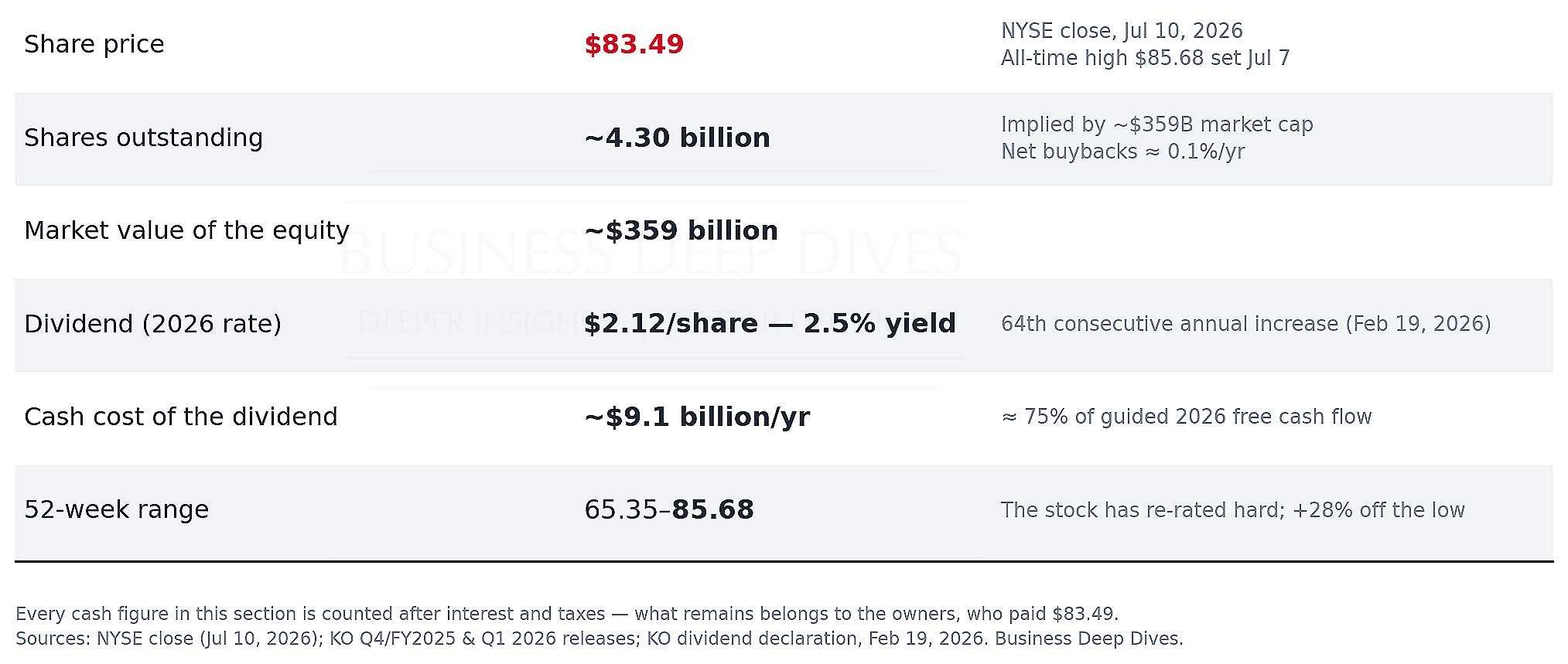
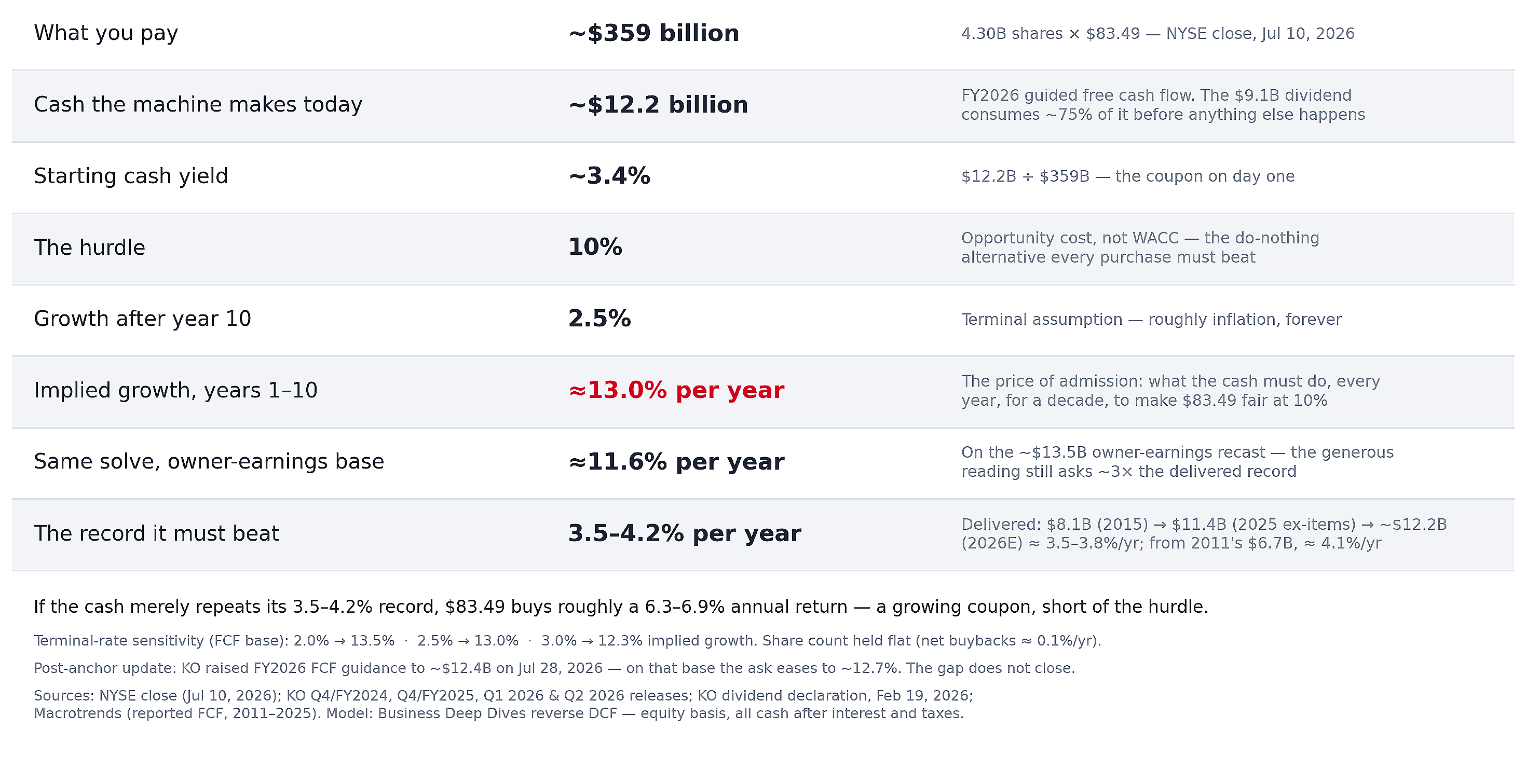
Coca-Cola's reported free cash flow was $8.1 billion in 2015 and $6.7 billion as far back as 2011; guidance for 2026 calls for roughly $12.2 billion. That is compounding of about 3.5–3.8% a year over the past decade, about 4.1% over fifteen years and the grim-looking 2024 and 2025 prints are really just accounting artifacts in our opinion. 2024 absorbed the $6.0 billion IRS tax litigation deposit, leaving $10.8 billion underneath, and 2025 absorbed the final $6.1 billion fairlife earn-out, leaving $11.4 billion. Against that record, $83.49 asks for roughly 13% a year for a decade — better than three times the delivered rate — and the setup table shows why the growth cannot be manufactured: $9.1 billion of the $12.2 billion is already pledged to a dividend with a 64-year streak, and net buybacks retire ~0.1% of shares a year, so the denominator will not shrink to flatter the arithmetic. The growth must come out of operations. The mirror states the cost of being wrong gently: if the next decade merely repeats the last one, the buyer at $83.49 collects roughly 6.3–6.9% a year — a durable, growing coupon, but a below-hurdle one
Appendix A — Timeline (1886–2026)
1886–1929: Foundations and the Woodruff Transition
1886 — John Pemberton creates Coca-Cola syrup; first sold at Jacob’s Pharmacy in Atlanta on May 8. Priced at 5¢ a glass.
1887 — Coca-Cola name and Spencerian script logo devised by Frank Robinson.
1888 — Coca-Cola pioneers the free coupon — mailing certificates for a complimentary glass. Pemberton dies; Asa Candler begins acquiring majority ownership of the formula amid murky transactions.
1892 — Asa Candler founds The Coca-Cola Company. First-year results: ~36,000 gallons of syrup sold, ~$46k revenue, $12k profit. Aggressive advertising and expansion plans commence.
1893 — Coca-Cola’s trademark registered at the U.S. Patent Office.
1895 — Coca-Cola sold in every U.S. state. Slogan “Delicious and Refreshing” dominates ads. Cocaine content cut as public opinion shifts (completely removed by 1903).
1899 — Landmark bottling agreement: Candler grants U.S. bottling rights to Thomas and Whitehead for $1. Spawns a nationwide network of franchised bottlers and sets the 5¢ price for decades.
1905 — U.S. Pure Food and Drug Act pressures Coca-Cola on its ingredients. Federal trademark protection achieved under new law. Coca-Cola begins using de-cocainized coca leaf extract.
1909–1911 — U.S. government sues Coca-Cola over caffeine content. Coca-Cola wins, but reduces caffeine and sharpens its wholesome marketing.
1915–1916 — Contour Bottle introduced (patented 1915, rolled out 1916). Becomes a powerful brand symbol and defensive asset (trademarked in 1960).
1916 — Asa Candler retires; transfers control to his children. WWI brings sugar rationing.
1919 — Candler family sells The Coca-Cola Company to Ernest Woodruff’s syndicate for $25 million. The company is taken public. Secret formula written down for the first time and put in a bank vault as loan collateral.
1920 — Coca-Cola wins the Supreme Court “Koke” case, cementing exclusive meaning for the name. By now, over 7,000 would-be competitors have been eliminated via legal action or market muscle.
1923 — Robert Woodruff becomes president at age 33. Initiates efficiency improvements and massive advertising expansion. Marketing shifts to lifestyle association (”Thirst Knows No Season” Christmas campaign, 1922).
1928 — Coca-Cola is a sponsor at the Amsterdam Olympics. Bottle sales surpass fountain sales for the first time.
1929 — Archie Lee and Woodruff launch “The Pause That Refreshes.” Coca-Cola sales hit record highs despite the stock market crash.
1931–1971: Depression, War, Television, and the Cola Wars
1931 — Sundblom Santa debuts. Defines Coca-Cola Christmas advertising for decades.
1934 — Pepsi begins selling 12-ounce bottles for 5¢ — “Twice as much for a nickel.” First significant price/volume challenge to Coca-Cola.
1941–45 — WWII: Coca-Cola classified as essential to troop morale. 64 portable bottling plants built in war zones, 5+ billion bottles supplied to GIs. Pepsi and other rivals receive no such support.
1945–50 — Foreign earnings rise to a meaningful share of company profit by the early 1950s — commonly cited around one-third — building on the wartime bottling expansion.
1947 — German bottler’s wartime invention Fanta becomes an official Coke product in Europe.
1950 — Alfred Steele (formerly Coke’s marketing VP) becomes CEO of Pepsi. Coca-Cola featured on the cover of Time magazine — Coke’s red disc offering a Coke to the planet.
Early 1950s — Pepsi targets Black consumers with all-Black sales force, positions itself as “lighter,” embraces TV with youth-oriented stars (James Dean’s first on-screen role was a Pepsi ad).
1955 — Pepsi’s postwar resurgence under Steele reaches its peak. Coca-Cola switches advertising agencies to McCann Erickson. Ray Kroc partners with Coke for McDonald’s expansion.
1957 — McCann’s blind taste test: consumers prefer Pepsi. Woodruff orders results buried.
1959 — The 5¢ Coke phased out after 73 years.
1960 — Coca-Cola acquires Minute Maid (first diversification beyond carbonated beverages). 12-oz aluminum cans debut. Sprite launched 1961.
1962–63 — TaB launched as Coke’s first diet soda — Woodruff vetoes “Diet Coca-Cola” branding.
1965 — PepsiCo formed via Pepsi/Frito-Lay merger. Coca-Cola passes on the chance to acquire Frito-Lay.
1968 — “It’s the Real Thing” launched.
1970 — Pepsi outsells Coca-Cola in U.S. supermarkets for the first time in some regions.
1971 — “Hilltop” commercial airs. “I’d Like to Teach the World to Sing” becomes a hit single. Pepsi launches “The Choice of a New Generation.”
1975–1985: Pepsi Challenge and Leadership Inflection
1975 — Pepsi unveils the Pepsi Challenge — public blind taste tests showing Pepsi preference. Coca-Cola, paralyzed by Woodruff’s refusal to change and CEO Austin’s Alzheimer’s, doesn’t respond. Pepsi gains share every year through 1985; Coke loses every year.
1978 — Coca-Cola signs a December 1978 agreement with the China National Cereals, Oils and Foodstuffs Corporation, re-entering the People’s Republic of China after a thirty-year absence — among the very first foreign packaged-beverage entrants of the post-reform era.
1980 — Austin retires. Roberto Goizueta becomes CEO. Federal antitrust amendment permits exclusive territories for soft drink bottlers.
1982 — Diet Coke launches under the Coca-Cola name. Quickly becomes the top diet soda.
1985 — New Coke launches in April; Coca-Cola Classic returns in 79 days. Within a year, Classic surpasses pre-debacle share.
1986–2004: Goizueta and the Path to Total Beverage
1986 — Coca-Cola Enterprises (CCE) created via consolidation of major bottlers. Goes public.
1988 — Powerade launches. Warren Buffett begins buying Coca-Cola stock; ~7% stake by 1989; Buffett joins board.
1989 — Coca-Cola sells Columbia Pictures to Sony (CAA’s Ovitz brokers).
1990–91 — Coke and Pepsi battle for Eastern European and former Soviet markets. Coca-Cola sends free Cokes to U.S. Gulf War troops.
1992 — Coca-Cola hands its $200M+ ad account to CAA. “Always Coca-Cola” launches. Polar Bear Christmas ads debut 1993.
1993–96 — Coke acquires Thums Up (India), Barq’s (1995). Sponsors 1996 Atlanta Olympics. Pepsi/Starbucks form bottled-coffee partnership (1994) — Coca-Cola has no equivalent.
1997 — Roberto Goizueta dies. Coca-Cola’s market cap had grown from ~$4B at his ascent (1981) to over $150B. Doug Ivester becomes CEO.
1998–99 — Coke launches Dasani (1999). Belgian contamination scare forces European recall. Pepsi acquires Tropicana, outbidding Coke.
2000 — Ivester’s $16B Quaker Oats/Gatorade bid collapses without board approval. Ivester resigns. Douglas Daft becomes CEO. PepsiCo acquires Quaker Oats in early 2001.
2001 — Coca-Cola acquires Odwalla, takes minority stake in Glacéau (Vitaminwater).
2004 — Neville Isdell brought out of retirement as CEO. Articulates “Total Beverage Company” vision. Begins planning major bottler restructuring.
2005–2026: The Total Beverage Company Era
2005 — Coca-Cola Zero introduced in North America. Eventually available in 150+ countries.
2007 — Coca-Cola acquires Glacéau (Vitaminwater, Smartwater) for $4.1 billion — its largest deal to date.
2009 — China blocks Coca-Cola’s $2.4 billion Huiyuan Juice acquisition under antitrust law.
2010 — Coca-Cola Company buys CCE’s North American operations for $12.3 billion. CCE’s European operations spin off. Refranchising plans begin.
2014 — Coca-Cola announces 16.7% stake in Monster Beverage for $2.15 billion (closes 2015). Energy/non-energy brand swap.
2017 — James Quincey becomes CEO. “Beverages for Life” strategy; SKU pruning begins. Coke Zero Sugar reformulated globally with improved taste.
2018 — Coca-Cola agrees to buy Costa Coffee for $5.1 billion (largest deal in company history). Acquires 15% stake in BodyArmor for $300M.
2020 — COVID-19. Coca-Cola announces brand portfolio cull from ~500 to 200. TaB, ZICO, Odwalla, Honest Tea among those eliminated. 58th consecutive dividend increase.
2021 — Coca-Cola acquires remaining BodyArmor for $5.6 billion (largest brand acquisition ever). Topo Chico Hard Seltzer launches via Molson Coors partnership.
2022 — 60 consecutive years of dividend increases. Berkshire’s annual dividend from Coke reaches ~$704 million. Coca-Cola Amatil merges into Coca-Cola Europacific Partners. Company pledges to sell 25% of volumes in refillable or returnable packaging by 2030.
2023 — Q1 reports ~10% price/mix growth, 3% volume growth. Stock hits a then-record high. “Masterpiece” global campaign uses AI imagery.
2024 — 62nd consecutive annual dividend increase. Brand value $61.2B (Interbrand #7). Following the U.S. Tax Court’s final decision in the long-running IRS transfer-pricing case, Coca-Cola deposits $6.0 billion with the IRS (against invoices issued in September) and appeals to the Eleventh Circuit; reported free cash flow falls to $4.7 billion ($10.8 billion excluding the deposit). December: environmental goals reset to 2035 targets — the 25%-reusable pledge is dropped.
2025 — 63rd consecutive annual dividend increase (to $2.04/share). Henrique Braun becomes EVP and COO (January 1). March: final fairlife milestone payment of ~$6.2 billion. August–December: sale of Costa Coffee explored via Lazard — TDR Capital emerges as preferred bidder at roughly half the 2018 price — before talks end in December. October 21: agreement to sell a controlling interest in Coca-Cola Beverages Africa to Coca-Cola HBC, with closing expected by end-2026. December 10: CEO succession announced — Braun to succeed James Quincey on March 31, 2026, Quincey moving to Executive Chairman. FY2025 free cash flow: $5.3 billion reported; $11.4 billion excluding the fairlife payment.
2026 (through July) — January: Costa sale abandoned after bids fall short; the CFO later confirms full retention, with the China operations under review. February 19: 64th consecutive annual dividend increase, to $2.12/share. March 31: Henrique Braun becomes CEO; Quincey becomes Executive Chairman. April 28: Q1 results reaffirm ~$12.2 billion free-cash-flow guidance. June 25: the Eleventh Circuit hears oral argument in the IRS transfer-pricing appeal — the $6.0 billion deposit sits pending, against a company-estimated aggregate exposure of up to ~$14 billion (2010–2025) under the Tax Court methodology. A FIFA World Cup campaign runs across 180+ markets; Q2 Trademark Coca-Cola volume grows 5%, the strongest in 17 years excluding COVID recovery. July 7: shares reach an all-time high of $85.68. July 10: $83.49 close (~$359 billion market cap) — the valuation anchor of this report. July 28: Q2 results; full-year guidance raised (organic revenue ~5%; comparable EPS +9–10%; free cash flow ~$12.4 billion).
Appendix B — Key Individuals
John S. Pemberton — Atlanta pharmacist and wounded Civil War veteran who invented Coca-Cola in 1886, trying to cure his own ailments and make money. A capable chemist and a poor businessman; sold the product off in pieces before dying in 1888.
Frank M. Robinson — Pemberton’s bookkeeper-partner and the brand’s first marketing mind: coined the name “Coca-Cola,” drew the Spencerian-script logo, pioneered the coupon, and brought Asa Candler on board.
Asa Griggs Candler — Pharmacist-turned-tycoon who acquired Coca-Cola in 1888–1891 and founded The Coca-Cola Company in 1892. Pushed the drink into every U.S. state by 1895 on lavish advertising and branded merchandise; ran the company until 1916 and sold it in 1919.
Benjamin Thomas & Joseph Whitehead — Chattanooga businessmen who secured U.S. bottling rights from Candler for $1 in 1899 and built the franchise bottling system by selling territories. Their vision proved revolutionary; the contract’s perpetual terms haunted the company for decades.
Harold Hirsch — Coca-Cola’s lead counsel in the early 20th century. Fought imitators all the way to the Supreme Court (the 1920 Koke case) and orchestrated the contour bottle as a legal strategy to protect Coke’s trade dress.
Ernest Woodruff — Atlanta financier who led the 1919 purchase from the Candler family, took the company public, modernized its structure, and installed his son.
Robert W. Woodruff — President from 1923 to 1954 and de facto patriarch into the 1980s. Built the culture of quality and ubiquity — Coca-Cola “within an arm’s reach of desire” — and ran the WWII nickel-Coke program. His later traditionalism slowed the response to diet colas, television, and Pepsi. Died 1985.
Archie Lee — D’Arcy Agency adman of the 1920s–30s. Coined “The Pause That Refreshes,” enforced visual and verbal consistency, and, with artists like Rockwell and Sundblom, built the Americana canon.
Haddon Sundblom — Swedish-American illustrator who painted the definitive Coca-Cola Santa — rosy-cheeked, dressed in Coca-Cola red — from 1931 to 1964.
Walter Mack — Pepsi president of the 1930s–40s. Kept Pepsi alive through the Depression (the 12-ounce nickel bottle), repeatedly tried to sell it to Coca-Cola, and won Pepsi’s legal right to the word “cola.”
Alfred Steele — Former Coca-Cola marketing executive who became Pepsi CEO in 1950 and turned the perpetual underdog into a genuine competitor: targeted marketing to Black consumers, “lighter” positioning, youth-oriented television. Married Joan Crawford in 1955; died unexpectedly in 1959.
Ray Kroc — Founder of McDonald’s Corporation, 1955. Chose Coca-Cola as his beverage partner from day one and never replaced it, even as he squeezed every other supplier.
J. Paul Austin — CEO 1962–1979. Presided over international growth, then over drift as Alzheimer’s advanced and Pepsi gained. Retired 1980.
John Sculley — Pepsi marketing executive who helped mastermind the 1975 Pepsi Challenge; the campaign reset the Cola Wars. Hired by Steve Jobs in 1983 to run Apple.
Roberto Goizueta — Cuban-born chemist-turned-executive; CEO from August 1980 until his death in October 1997, and the defining leader of the modern era. Launched Diet Coke, ordered New Coke and the swift Classic recovery, and drove market value from ~$4 billion to over $150 billion.
Don Keough — President and COO of the 1980s, Goizueta’s closest operating partner. Delivered the July 11, 1985 Classic-return line: “we are not that dumb, and we are not that smart.” Later a Berkshire Hathaway director; died 2015.
Warren Buffett — Chairman of Berkshire Hathaway, which he ran as CEO from 1965 until handing the role to Greg Abel at the start of 2026. Built Berkshire’s Coca-Cola position in 1988–1994 (~$1.299 billion cost basis; board seat 1989–2006). The 400-million-share stake — roughly 9.3% of the company — was worth ~$33.4 billion at the July 10, 2026 anchor price and earns $848 million a year at the current $2.12 dividend rate.
Michael Ovitz — CAA co-founder and Hollywood dealmaker. Brokered the Columbia–Sony sale in 1989, then took Coca-Cola’s advertising account from McCann Erickson in 1992; the polar bears followed in 1993.
Douglas Ivester — CEO 1997–2000. Longtime Coke accountant whose tenure was marred by the collapsed Quaker Oats/Gatorade bid; resigned under pressure at the end of 1999.
Douglas Daft — CEO 2000–2004. Initiated “Think Local, Act Local,” presided over painful cost cuts and modest results; retired mid-2004.
Neville Isdell — CEO 2004–2008. Irish-born Coke veteran brought out of retirement; stabilized the company, championed the “total beverage company” vision, launched Coke Zero, and initiated the bottler restructuring that led to the 2010 CCE deal.
Muhtar Kent — CEO 2008–2017. Turkish-American Coke veteran who led the emerging-markets push and the $12.3 billion CCE North America acquisition, then the refranchising that unwound it.
James Quincey — CEO 2017–March 2026, now Executive Chairman. Drove the SKU pruning and 2020 brand cull, the Costa and BodyArmor acquisitions (both of which underperformed their theses), the completion of the fairlife earn-out, and the IRS litigation defense — adding more than 10 billion-dollar brands along the way.
Henrique Braun — Brazilian Coca-Cola veteran who rose through the Latin America business; EVP and COO from January 1, 2025. Elected CEO on December 10, 2025, effective March 31, 2026.
Appendix C — Claims & Evidence
This appendix consolidates the report’s key factual claims and points to the strongest source available for each. Citations follow the numbered Footnotes section (below). Where the underlying evidence is uncertain, the claim is presented with appropriate hedging in the body.
Founding and origin (1860s–1890s). Pemberton’s morphine addiction (rooted in Civil War wounds) and his progression from Pemberton’s French Wine Coca to a non-alcoholic Coca-Cola in response to Atlanta’s 1885 Prohibition law are documented by Mark Pendergrast, For God, Country and Coca-Cola (3rd ed.) and corroborated by the Coca-Cola Company heritage archive and the Library of Congress. The May 8, 1886 first sale at Jacobs’ Pharmacy and Frank M. Robinson’s coining of the name and Spencerian-script logo are recorded in the Coca-Cola Company’s official heritage page and the Georgia Historical Society marker at the original site.
Candler era (1888–1919). The roughly $2,300 cumulative purchase price by which Asa Candler consolidated full ownership over 1888–1891 is given in the Coca-Cola Company’s “Asa Candler Era” heritage page and reproduced in Britannica and Wikipedia citing Charles Howard Candler’s 1950 biography of his father. Incorporation of The Coca-Cola Company in Georgia in 1892 and the 1893 federal trademark registration are official heritage facts. Candler’s reported sale to the Woodruff syndicate for $25 million in 1919 is on the heritage timeline and on the Georgia Historical Society marker.
The 1899 bottling contract. The terms — exclusive U.S. bottling rights granted to Benjamin F. Thomas and Joseph B. Whitehead for a nominal $1, with a fixed syrup price subsequently set at $1.00 per gallon (less a 10¢ rebate) and a perpetual term — are on the public record via Coca-Cola Bottling Co. v. Coca-Cola Co., 769 F. Supp. 671 (D. Del. 1991), which reproduces and litigates the contract’s terms. The Tennessee Encyclopedia and the American Business History Center provide complementary narrative accounts.
Trademark and bottle moat. The Supreme Court’s 1920 ruling that “Coca-Cola” had acquired a “secondary significance” referring to the plaintiff’s product alone is The Coca-Cola Company v. The Koke Company of America, 254 U.S. 143 (1920), Holmes, J., available in the U.S. Reports via the Library of Congress and Cornell LII. The 1916 caffeine litigation is United States v. Forty Barrels and Twenty Kegs of Coca-Cola, 241 U.S. 265 (1916), Hughes, J. The contour bottle’s federal trademark is U.S. Registration No. 696,147, filed March 19, 1959 and registered April 12, 1960 (USPTO record); the company’s own heritage page dates the recognition to April 12, 1961, but the registry record controls and the timeline uses 1960. The 1949 recognition study (fewer than 1% of Americans could not identify the bottle by shape) is a company-commissioned figure reported on that heritage page and cited by the company in obtaining the registration; independent confirmation of the underlying methodology is not publicly available, so the claim is presented as the company’s own.
Wartime program (1941–1945). The Woodruff order to supply Coca-Cola at five cents to every U.S. service member, the 64 portable bottling plants installed overseas, and the more than 5 billion bottles consumed by service personnel are recounted in the Coca-Cola Company’s “Symbol of Friendship” heritage page and corroborated in the U.S. National WWII Museum, the USO’s partnership history, and Pendergrast (3rd ed.). The “essential morale-building products” quotation is from a War Department–era exchange cited in Pendergrast.
Pepsi’s 1950s resurgence (Steele era). Britannica reports Pepsi’s earnings rising approximately eleven-fold across the decade. The oft-quoted market-share path — low-20s into the mid-30s by 1955 — cannot be anchored to a primary industry source; the figure is therefore omitted from the timeline, and the resurgence is characterized directionally, as evidenced in Pendergrast and the American Business History Center.
The hidden 1957 taste test. McCann Erickson’s blind taste test showing Pepsi preference and Woodruff’s order to bury the result is described in Pendergrast and in Frederick Allen, Secret Formula. Independent contemporaneous press confirmation is limited; the claim rests on the Allen and Pendergrast reconstructions of the company’s internal accounts.
Pepsi’s repeated offers to sell. The reports that Pepsi-Cola, after its 1923 and 1931 bankruptcies, offered to sell itself to Coca-Cola on three occasions between 1922 and 1934 are well established in beverage-industry histories, including Pendergrast (3rd ed.), the Cola Wars literature, and the American Business History Center’s “The Little Soft Drink That Could.”
McDonald’s partnership (1955). The Kroc–Coca-Cola handshake, stainless-steel syrup tanks, and most-favoured-customer pricing rule appear in Frederick Allen, Secret Formula, in McDonald’s corporate communications, and are recounted in Bloomberg Businessweek’s coverage of the partnership’s anniversary.
Soft Drink Interbrand Competition Act (1980). Public Law 96-308, signed July 9, 1980, by President Carter, codified at 15 U.S.C. ch. 61, made exclusive territorial provisions in soft-drink bottling licenses lawful under the antitrust laws.
New Coke and the Classic return (1985). The 79-day reversal, Don Keough’s “we are not that dumb” press-conference line, and the subsequent rebound in Classic’s market share are documented in contemporary press coverage (NYT, WSJ, Time) and in the Coca-Cola Company’s 100th-anniversary materials.
Buffett / Berkshire stake (1988–present). The accumulation of Berkshire’s roughly $1.299 billion cost basis (about $3.25 per split-adjusted share) over 1988–1994 is on the public record in Berkshire’s annual reports and shareholder letters. Berkshire has held 400 million Coca-Cola shares (roughly 9.3% of outstanding) since 1994, generating dividend income of approximately $704 million in 2022, $776 million in 2024, and $848 million on the $2.12 annual rate declared February 19, 2026 — a yield on cost that has climbed from roughly 54% to roughly 65% across that span, with cumulative dividends in excess of $11 billion. At the July 10, 2026 anchor price of $83.49, the position was worth approximately $33.4 billion. The popular “ham sandwich could run it” phrasing is attributed to Buffett in Schroeder’s The Snowball; Buffett denied having said it in a 2014 CNBC interview with Becky Quick, and the report treats the line as apocryphal.
CAA / “Always Coca-Cola” (1992). The transition from McCann Erickson to Creative Artists Agency is covered in AdAge, NYT, and Pendergrast.
Quaker / Gatorade collapse (2000). Coverage in NYT, Wall Street Journal, and Coca-Cola’s contemporaneous SEC filings document the failed $16 billion bid and the subsequent PepsiCo acquisition of Quaker in 2001.
2010 CCE acquisition. “FTC Puts Conditions on Coca-Cola’s $12.3 Billion Acquisition of its Largest North American Bottler” (FTC press release, September 27, 2010); related Coca-Cola 8-K filings.
Glacéau / Vitaminwater (2007). Coca-Cola Company press release dated May 25, 2007; subsequent 8-K filings; CBS / NBC / CNBC contemporaneous coverage.
Monster Beverage (2014). Joint Coca-Cola / Monster press release, August 14, 2014; SEC filings.
Costa Coffee (2018). Coca-Cola Company press release, August 31, 2018; closing announcement, January 3, 2019; Whitbread shareholder filings.
BodyArmor (2021). Coca-Cola Company press release, November 1, 2021; subsequent 10-K filings.
Brand-portfolio cull (2020). Coca-Cola Q3 2020 earnings call and contemporaneous Fast Company, Reuters, Wall Street Journal coverage. The “30 billion-dollar brands” phrasing is used by James Quincey at CAGNY 2025 (BeverageDaily, March 2025); the most recent count on the Coca-Cola corporate site is 32 billion-dollar brands.
Corporate events, 2024–2026. The $6.0 billion IRS tax litigation deposit and its effect on 2024 cash flow ($4.7 billion reported free cash flow; $10.8 billion excluding the deposit) are per Coca-Cola’s Q4/FY2024 earnings release (February 11, 2025); the deposit’s refundable status pending appeal, the June 25, 2026 Eleventh Circuit oral argument, and the company’s estimate of up to ~$14 billion aggregate incremental exposure for 2010–2025 under the Tax Court methodology are per the Q2 2026 Form 10-Q. The final fairlife contingent-consideration payment (liability of $6,173 million, paid March 2025) is per the Q1 2025 Form 10-Q and earnings call; FY2025 free cash flow of $5.3 billion ($11.4 billion excluding the fairlife payment) is per the Q4/FY2025 earnings release (February 10, 2026). The December 2024 reset of environmental goals to 2035 targets, dropping the 25%-reusable-by-2030 pledge (announced 2022), is per the company’s announcement and contemporaneous coverage (Washington Post; Packaging Dive; ESG Today). The Costa Coffee process — Lazard-run review from August 2025 (Sky News), TDR Capital as preferred bidder at roughly £2 billion versus the £3.9 billion 2018 price, talks ending December 2025, abandonment reported January 14, 2026 (Financial Times), and the CFO’s February 2026 confirmation of full retention with the China operations under review (Bloomberg) — is per the cited outlets. The agreement to sell a controlling interest in Coca-Cola Beverages Africa to Coca-Cola HBC is per the October 21, 2025 announcement, with the closing assumption per the Q1 2026 release. The CEO succession — Henrique Braun elected December 10, 2025, effective March 31, 2026; James Quincey to Executive Chairman — is per the company’s press release and Form 8-K. The 64th consecutive dividend increase to $2.12 annualized is per the February 19, 2026 declaration. Full-year 2026 guidance of ~$12.2 billion free cash flow (Q1 release, April 28, 2026), raised to ~$12.4 billion with organic revenue of ~5% and comparable EPS growth of 9–10% (Q2 release, July 28, 2026), is per the respective earnings releases. The July 7, 2026 all-time high of $85.68 and the July 10, 2026 close of $83.49 (~$359 billion market capitalization on 4.30 billion shares) are per NYSE data.
Servings per day (fiscal 2024). The Coca-Cola Company 2024 Form 10-K: “Beverages bearing trademarks owned by or licensed to the Company account for 2.2 billion of the estimated 65 billion servings of all beverages consumed worldwide every day.”
Market capitalisation (anchor). Approximately $359 billion as of July 10, 2026 — 4.30 billion shares at the $83.49 NYSE close. All valuation work in this report is anchored to that date; developments after July 10 are flagged as post-anchor updates where they appear.
Pricing power (2022–2023). Coca-Cola Company quarterly earnings releases for 2022 and 2023; CFO commentary on Q1 and Q2 2023 calls.
We appreciate your time in reading our Coca-Cola Evolution Series Report. We hope this is the first of many. How we made this can be viewed in our Research Standard page.
Disclosures and Disclaimers
This report is for informational and educational purposes only and does not constitute investment advice, a recommendation, or a solicitation to buy or sell any securities. All opinions expressed reflect the author’s judgment as of the publication date and are subject to change without notice.
The author does not currently hold shares of The Coca-Cola Company (KO) but may initiate a position in the future without further notice.
For the full disclaimer, click here.
Copyright © 2025 Business Deep Dives. All rights reserved.
Business Deep Dives is an independent research publication operating on a pre-incorporation basis. All content is protected under applicable international copyright principles.